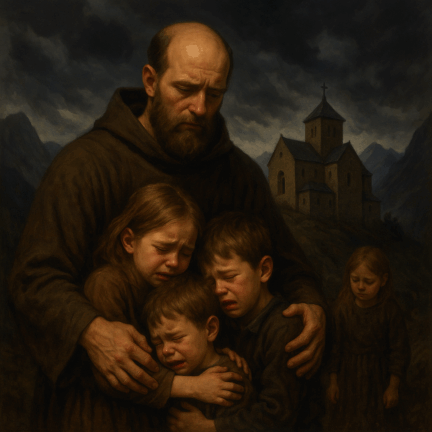
The agonizing Grief of Children of Divorce: A Cry from the Dark Night of the Soul
In the icy shadows of the Alps, where the Nigredo Monastery stands like a bulwark of truth against the tides of chaos, I hear the breaking hearts of the innocent. The children! Oh, woe to the children of shattered families, whose souls shatter like delicate glass under the hammer of divorce. Here, in the Nigredo phase of alchemical transformation—the pitch-black darkness that heralds the death of the old and ushers in the agonizing birth struggle of the new—I encounter their silent cries.
These cries, trivialized by witches and eunuch-like fathers—those emasculated shadow men who have surrendered to wokeism—as if it were merely a “transition,” a “new beginning.” Trivialized? It is murder of the soul! A spiritual and psychological robbery that plunges the children into abysses of emptiness where no truth, no beauty, no goodness can endure.
They must grieve as the father grieves for the Holy Family—in deep, masculine devotion to God, in a healthy masculinity that protects and heals. Only in this way can they survive, within a morally sound framework shaped by reason, religion, and the unwavering mysticism of Christ.
For divorce is not merely a break—it is the spiritual death of the family, that divine image of the Trinity: father, mother, and child. A death that throws children into a hell of confusion, where they learn that love is fragile, trust is a lie, and the world is a place of merciless selfishness.
Divorce is worse than death! When a family falls apart, life is thrown off balance like a ship in a raging storm, losing its sails and helplessly adrift. Routines shatter into pieces, familiar roles dissolve like mist in the morning breeze, and the heart—ah, the tender heart of a child! —is pierced by a pain that cuts deeper than any sword. Emptiness yawns like an abyss, questions echo: Why? Why us? Why God?
Grief
Grief is not a fleeting illness that 'passes' with cheap bandages, but a mystical path through the dark night of the soul, as John of the Cross described it in holy ecstasy. It demands an inner reorientation—a desperate return to a new order founded on the goodness, truth, and beauty of God. Yet in our desecrated age, where the Church itself has degenerated into a Babylonian whore and eunuchs hold sway in its halls, this grief is trivialized in children of divorce.
Look ahead!' whisper the witches who, in their selfish 'self-realization'—that perversion of healthy womanhood—tear apart the sacred bond of marriage. And the eunuch-like fathers nod weakly, too cowardly to fight, too emasculated to protect. They trivialize the damage: the spiritual rift that turns children into disoriented shadows, susceptible to the ideologies of evil; the gangrene that drives them into loneliness, anger, and despair, where they learn that family—the foundation of the state, society, and humanity—is fragile.
This damage is irreversible if there is no mourning: children become broken souls who never fully trust again, never fully love again, trapped in a world without God, without morality, without reason.
At Nigredo Monastery, Master Reding accompanies the broken on this path of healing: through rituals of Christian mysticism, prayers that embrace the paradox of suffering like a Zen koan, memorial ceremonies, and silent contemplation within the rigorous discipline of healthy masculinity. Here, grief is brought outward—not hidden in the soft, woke illusion of "progress," but unleashed in its raw power so that it can heal.
Woe to the mothers who, out of sheer selfishness, suppress the grieving process!
They abuse their children twice: first, by betraying marriage, which God has consecrated as indissoluble, and second, by stifling the natural agony to escape their guilt. And the eunuch-like fathers? They stand by, purring instead of roaring, and allow their sons and daughters to sink into spiritual misery. This is spiritual abuse, worse than any physical wound—it castrates the soul, turning potential warriors of the spirit into impotent victims.
The Grief Process
The stages of the grieving process for children of divorce resemble those of death, but they are filled with a deeper, heart-rending anguish that demands a moral reckoning with evil. Let us consider them in the light of Christian mysticism and the healthy masculinity that a father must embody to save his children.
The Denial
In the first, agonizing days after the divorce, unreality envelops the child like a suffocating fog. It hears the laughing voices of both parents echoing in the empty house.
The child, trembling, awaits the embrace at dinner, reaching for hands that are no longer there. Its heart pounds in panic: "This can't be happening!" This phase is God's merciful veil, a protection against the full horror. But when the mother—in a cold, trivializing way—tears this veil and forces the child to "look ahead," the damage explodes: The soul breaks early, the mental fortitude crumbles. The father must intervene here with masculine strength: Mourning the family like a fallen soldier on the battlefield, in tears and prayer.
Duration: Weeks—an eternity of suffering for the innocent child.
Unleashing Emotions
When the paralysis breaks, the pain pours forth like a torrent of blood from an open wound. Tears flow like rivers of despair, rage blazes like an inferno: "Why did you do this, Mother? Why didn't you fight for the family?" Guilt gnaws at the soul like worms – “Was I to blame? Didn’t I love enough?” The psychological damage becomes tangible: children learn mistrust, self-hatred, an emptiness that drives them to drugs, ideologies, or self-destruction. Within a morally sound framework, this phase must be allowed: not stifled by woeful comfort, but channeled through prayer, asceticism, and the harsh truth.
The father leads the way in mourning, showing that true strength lies in enduring – not in the cowardice of eunuchs. Women who trivialize this inflict immeasurable psychological damage: a sin against the beauty of motherhood, which God created sacred.
Duration: months, years – a purgatory that purifies when endured.
Searching and Letting Go
Here rages the inner battle, a tug-of-war between desperate longing and agonizing letting go. The child wanders through places of memory—the park where laughter once filled the air, the home that is now a grave—clinging to photographs, whispering prayers to the lost unity. It still senses the family: in the howling wind, in the bitter scent of bygone days, in a melody that tears the heart apart.
This inner turmoil is the mystical breakthrough where the paradox—emptiness as agonizing fullness—merges with Eckhart's apophase: The family dies, yet its spirit torments and heals simultaneously. Without this process, the soul rots from within, spiritually mutilated by trivialization. The father must guide: with relentless discipline.
Duration: months, years—an eternity of tears for the child.
Reorientation
Healing is only possible in a moral environment; only then is one safe. With time—by God's grace, never suddenly—a quiet peace seeps in, born from the blood of grief. Not everything heals, but the child learns to carry the memory of the broken family with gratitude, not with toxic bitterness. New paths open up, grounded in morality, reason, and religion. Grief doesn't end, but it transforms: victims become saints, strengthened in truth and goodness. I see it in the Nigredo Monastery: children of divorce who, through this path, become warriors of the spirit, men and women in a healthy state—not emasculated by wokeism, but redeemed in the light of Christ.
Woe to the women and eunuch-like fathers who, out of selfishness and cowardice, suppress the grieving process! They destroy the souls of their children, crippling them spiritually in a world without God.
The father must rise: mourn as for the dead, with manly resolve, to honor the family and save the innocent. Only in this way does healing come—in Nigredo, the darkness that leads to divine light. Come to us at Nigredo Monastery, where Master Reding sharpens the blade: not for the pillow of banality, but for the sword of mysticism. The family may be broken, but in the emotional depths of grief it will rise again – in beauty, truth, and the eternal goodness of God.