Distorted Sermon on the Mount through a Pacifist-Feminist Interpretation
In the Sermon on the Mount, Jesus Christ speaks words that still touch souls today and call them to conversion. Yet the sayings from Matthew 5:38–42 – turn the other cheek, go two miles, and give the cloak as well – are frequently misunderstood in our time. A pacifist-feminist interpretation reduces them to mere passivity and weakness. This reading is factually untenable and foolish. It ignores the historical context and distorts the true meaning. The words of Jesus are not a call to submission, but a courageous, active path of conversion in a hierarchically ordered world. Through the Logos, He turns the world upside down.

Turn the Other Cheek – No Toleration of Injustice
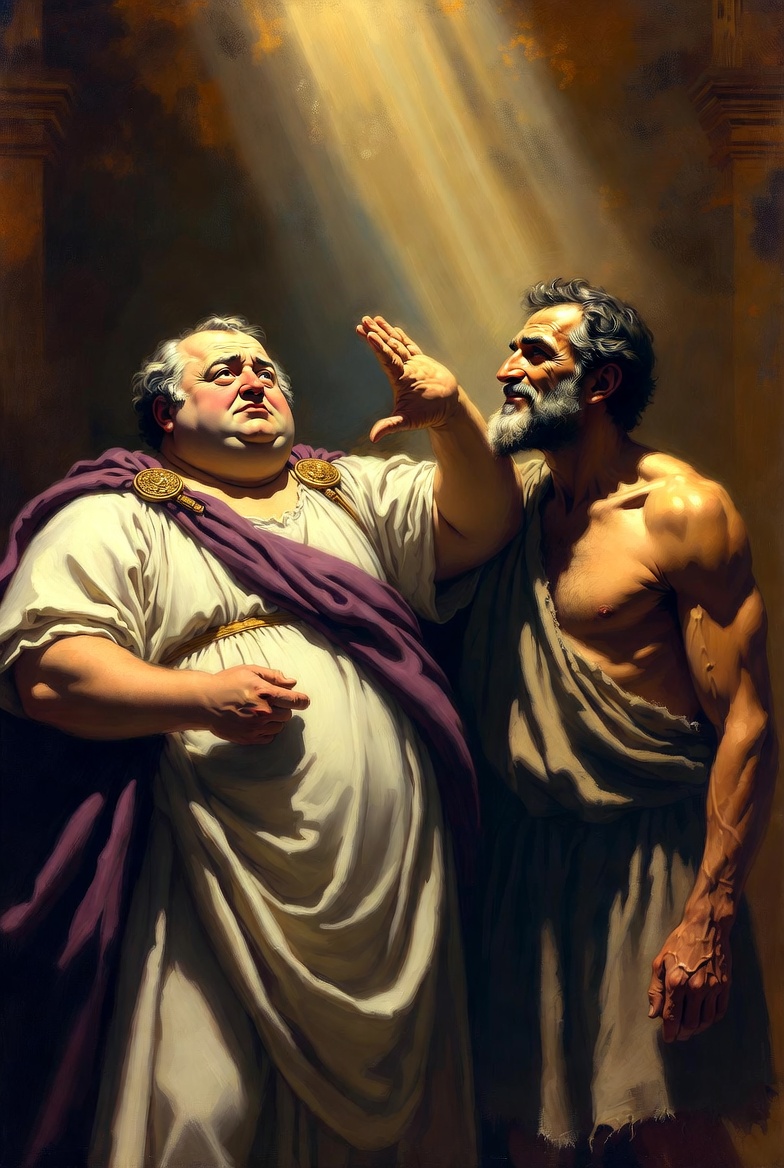
In the ancient context, a blow to the right cheek was a humiliating gesture delivered with the back of the hand. It expressed the superiority of the striker, as was common between master and subordinate.
Jesus says: “If anyone slaps you on the right cheek, turn to them the other cheek also.” The victim thereby offers the left cheek and forces the aggressor to strike with the open palm – a gesture permitted only between equals and one that could have legal consequences for the striker.
This is therefore not passive endurance, but an act of wise strength that places the aggressor in a genuine dilemma: either he acknowledges equality and thereby commits a punishable insult among peers, or he refrains and admits defeat.
Go Two Miles – The Reversal of Abuse
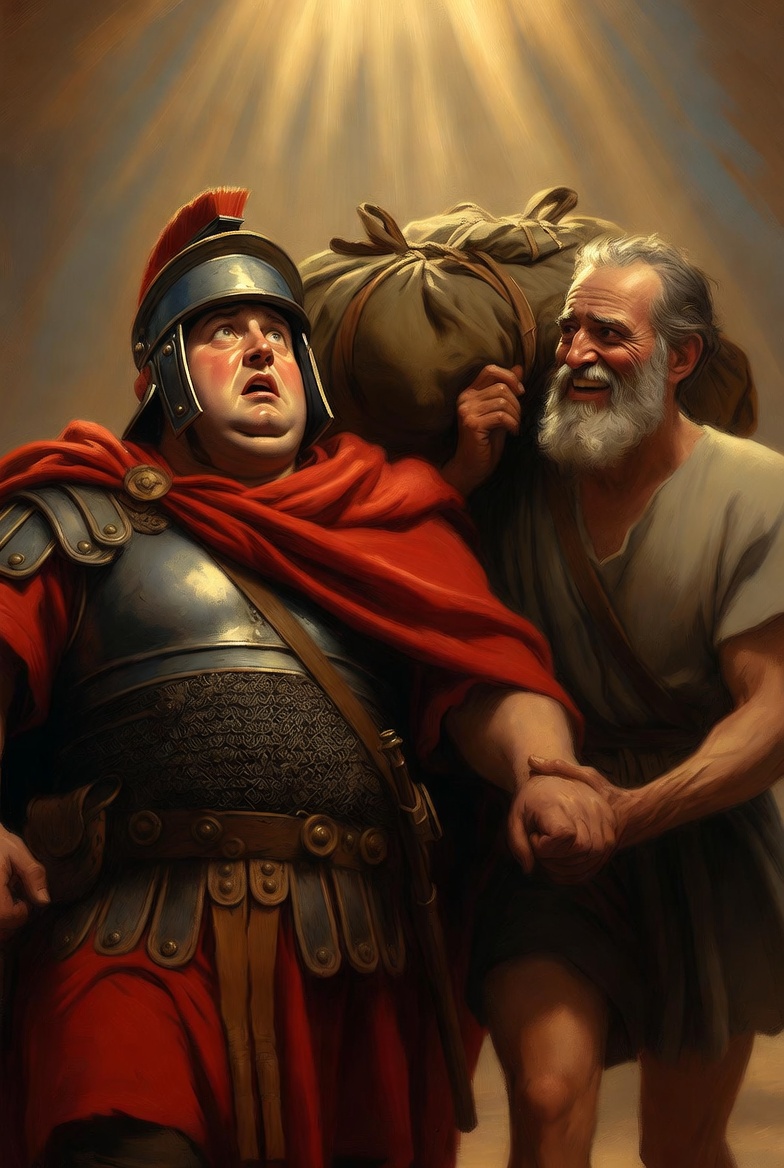
Roman soldiers were permitted under the law of angaria to compel civilians to carry their baggage for exactly one mile. Demanding more was punishable. Jesus commands: “And if anyone forces you to go one mile, go with him two miles.”
The one compelled takes the initiative. By voluntarily going the second mile, he places the soldier in a legally precarious position, and the soldier faces harsh punishment. This is a wise action that grants the victim the possibility of conversion and puts the aggressor in a dilemma: he must immediately take back his baggage or make himself guilty of breaking the law.
Give the Cloak as Well – The Exposure of Shame
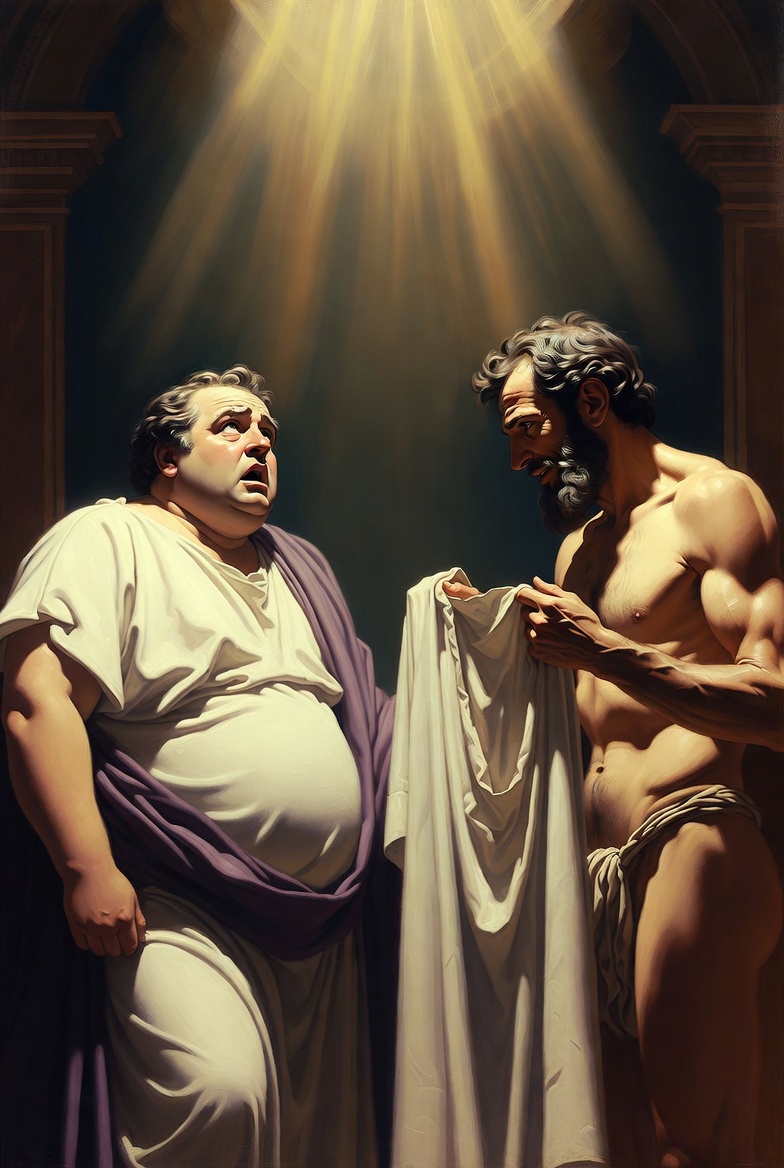
In the ancient law, public nakedness was considered a grave humiliation that could punish the one who caused it. If someone sued a poor man for his tunic in order to ruin him, Jesus says: “And if anyone wants to sue you and take your tunic, let him have your cloak as well.”
The affected person would then stand naked. The shame is reversed and falls upon the aggressor, who is now punished.
Former Hierarchies and the Lost Dynamic of Mutual Dependence
In former times, social order was clearly hierarchical. This structure was not mere oppression, but a reality of mutual dependence and responsibility. Subordinates also possessed power – often through passive influence, faithful service, or prudent restraint. Every station depended on the others. Clear power relations existed between senior and junior, yet all were interdependent. The service of the subordinate was indispensable to the whole.
In our effeminized society, this natural order has largely been lost. Instead, an ideological leveling prevails that rejects every hierarchy as oppression. It is precisely for this reason that the Bible is today often read through a pacifist-feminist lens: as a call to total non-violence and the dissolution of paternal authority. This interpretation is factually false and foolish. It alters the context and thereby distorts the meaning of Jesus’ words. Instead of wisdom for real power relations, a distorted image of pacifism emerges.
Pacifism as a Symptom of the Mother Complex – Conflict Avoidance
Pacifism is conflict avoidance and a symptom of the mother complex. It arises from the unconscious longing for complete equality and the avoidance of any paternal structure, boundaries, authority, and clear hierarchy. It is not about true equality before God, but about the reversal of existing power relations. The strong, ordering paternal side is rejected, while the maternal-merging side is overemphasized.
It is often interpreted to mean that one should simply do nothing, allow further humiliation, and expose oneself. This is utter nonsense and a consequence of trauma from the mother complex – conflict avoidance is pacifism. It leads only to resignation. It is the poison of the Death Mother, which forces passivity and refuses to recognize boundaries.
The sayings show exactly the opposite: they are a wise counterstrike that forces the aggressor to his knees. A return blow that brings the aggressor far greater punishment, even though he stands higher in the power hierarchy. Through this, the victim receives the possibility of conversion and not resignation, while the aggressor is caught in an inescapable moral and legal dilemma.
It shows a way to oppose injustice within hierarchical power structures. Instead of breaking the order, the victim uses the existing rules and limits of the hierarchy to expose evil through wisdom. The apparently weaker one becomes the stronger, who brings the more powerful into line without himself becoming a tyrant. He uses the system instead of destroying it.
The Ideological Distortion of the Sermon on the Mount without the Logos
But for the Death Mother and the eunuchs, the feminist-pacifist reading is naturally more comfortable. It relieves them of the hard, paternal, and wise confrontation with evil and allows them to linger in supposed gentleness without ever truly assuming responsibility for order, justice, and spiritual maturity. One need draw no boundaries and thus bear no responsibility.
The pacifist-feminist interpretation portrays Jesus as a soft, conflict-avoidant apostle of peace who rejects all authority and paternal strength. Such a reading ignores the historical background and the spiritual depth of the teaching for humanity as a whole. It replaces courageous love with ideological passivity, which ultimately strengthens evil and weakens the natural order.
It is the false passivity that never dies, that romantically consoles and is praised by the collective, but which becomes a misunderstood waiting that appears cautious (mindful) and wise, yet in reality is poisonous. The poison of the Death Mother that paralyzes and sterilizes us.
The Sermon on the Mount does not call for self-surrender, but for the highest spiritual maturity, responsibility, and courageous, reasonable love.
The Logos – The Sermon on the Mount Is This Timeless Message
The three sayings of Jesus are not a call to passivity; on the contrary, they are a call to the Logos. The Logos is the eternal sword that proceeds from the heart of the Father. It is not a sound among sounds, but the generative power itself that penetrates the void and grants fruitfulness. In the beginning was the Word, and the Word was with God, and God was the Word (John 1:1). This Word is living and active, sharper than any double-edged sword (Hebrews 4:12). It separates soul and spirit, joints and marrow – and yet heals in the same motion.
It is the seed of divine love that falls into the receptive soul to make it the bride of the Most High. May the Holy Spirit grant us the grace to understand these words factually and to live them in the everyday life of the family, in the community, and in society. Only in this way can the world be renewed through the power of the Cross – to the glory of the Father and the salvation of souls.
It is the one Word that breaks through all dualities: inner and outer, above and below, male and female become one in the Logos (Gospel of Thomas, Logion 22). Here the apophatic depth reveals itself: the Logos is not something one grasps or possesses – it is what one becomes when one lays aside the false. The Sermon on the Mount calls to conversion: “Whoever finds the mouth of the Father will no longer die” (Logion 108). The Logos is the mouth of the Father – generative, speaking, birthing. Whoever receives Him receives eternal life itself.
The Sermon on the Mount and the Holy Sword – Logos
The holy sword (Logos, the living Word) is always in hand. It brings death and bestows life at the same time. It is there, it is here, giving and taking in one and the same act. If you wish to hold it fast, you are free to hold it fast. If you wish to let it go, you are free to let it go.
Yet hear the paradox that the Logos itself sets before you: Tell me how it will be when one no longer makes a distinction between higher and lower – and it is indifferent to one which role one assumes?
Here lies the radical reversal of which the Sermon on the Mount speaks. The holy sword is not your possession, not your tool, not your enemy. It is the Logos that penetrates you before you think it. When you give up the distinction between the one who receives and the one who gives – when you need be neither host nor guest, but simply become the vessel in which the Word is born – then you have passed through the paradox. Then the sword is no longer in your hand, but you are in its hand. It kills the false self and bestows true life. It is the sword that strikes and the hand of the Father that blesses – one and the same.
The Paradox of the Word of Conversion – Bridge between Ego and Self – Gospel of Thomas
The Master used to say: “When you have understood that there is no way to say it, then you should know how to say it – for in the beginning was the Word.”
Yet beyond this nothing appears the one Word, the word of conversion – the holy sword, the Logos. It turns man around: away from self-absorbed navel-gazing, toward the symbolic Father in Heaven, in order to clear the space for the birth of the Word. In the Gospel of Thomas, the silent finding of the Logos suffices to enter the Kingdom. Both lead to the same goal: the radical openness to the Logos that begets and redeems. The paradox is not dissolved – it is suffered and passed through. And suddenly it is fullness, the nothing the womb of being.
The Birth of the Logos in the Soul – Eckhart and True Manhood
Meister Eckhart teaches: The eternal Word is born in the soul, not as a thought, but as living presence. This birth is generative and receptive at once. Here lies true manhood: not in raw violence or in none at all, but in fearless surrender to the generative principle; it is wise power. The man who opens himself to the Logos becomes a father: he begets life, protects the family, orders the household, speaks the saving word.
In a time when many exchange the Cross for the soft cushion and seek to emasculate the generative power of the Church, the Logos – as in the Gospel of Thomas and the koan of the holy sword – calls to conversion. Return to the Father! Let the Word be born in you! It is the sword that heals; the seed that bears fruit; the love that unites and completes.
In the name of the Father and of the Son and of the Holy Spirit. Amen.
