The Soul of Switzerland – Tell, Helvetia, and the Cross
The figure of William Tell is one of Switzerland's most powerful and enduring symbols. Whether he lived exactly as tradition recounts is ultimately not the crucial point. What is crucial is that his figure expresses a truth that transcends any single historical individual. William Tell is not merely a legendary figure, but a symbol. And that is precisely why he lives on.
Tell is far more than a man with a crossbow. He is the embodiment of the free individual. He is the image of a conscience that refuses to yield. He is the image of the person who acts in the decisive moment because, inwardly, he cannot do otherwise. In him, something is embodied that remains essential for Switzerland to this day: the connection between freedom, responsibility, resistance, and inner clarity.
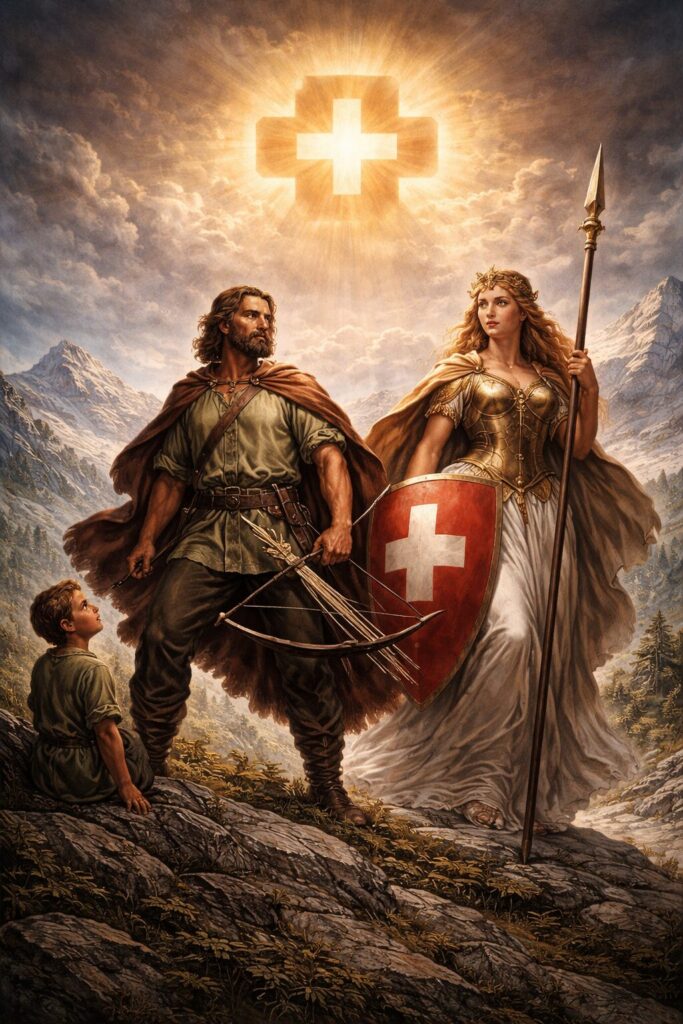
But the symbolism does not end with Tell alone. Beside him stands Helvetia, the feminine figure of Switzerland, with shield and spear. And above both of them is the cross in the Swiss coat of arms, which points to a center that is not man-made, but lies higher. Only in the interplay of these three symbols does the full picture emerge: William Tell, Helvetia, and the cross together form a spiritual framework that describes not only Switzerland but also an order of human existence.
William Tell as a Symbol of Freedom
At the heart of the Tell narrative is the refusal to bow before the hat of the bailiff Gessler. This scene appears simple at first glance, yet it already contains the full depth of the character. The hat is not merely a hat. It is a symbol of blind submission. Whoever bows before it does not bow before an object, but before a power that demands obedience for its own sake.
William Tell refuses this bow.
In doing so, he becomes the embodiment of a freedom that is not merely political. It is not primarily about a political program, but about something deeper: about the inner boundary at which a person says that they cannot do something without betraying themselves. This is precisely what makes Tell so powerful. He is not a theorist of freedom, but its embodiment. For him, freedom appears not as an idea, but as an attitude.
This freedom is essentially internal. Tell does not submit outwardly because he is unbroken inwardly. He recognizes that there is a limit beyond which conformity becomes self-denial. Therefore, Tell is not only a symbol of resistance against tyranny, but of the person who preserves their innermost core.
William Tell as a Symbol of the Self
It is precisely in this sense that William Tell can be understood as a symbol of the self. Here, "self" does not simply refer to the ego in the everyday sense, but to the inner core of the person, which cannot be entirely determined from the outside. This core is not loud. It does not constantly need to prove itself. It is not ideological. It is clear.
Tell represents this inner core. He is the person who does not act out of opportunism, not out of cowardice, not out of conformity to the spirit of the age. He acts from an inner certainty. He thus stands for the integrity of the individual. In a world of external pressure, Tell is the image of a person who remains steadfast within.
The entire Tell story can therefore also be read as an inner drama. Gessler is then not only an external tyrant, but also the symbol of all those forces that seek to mold, distort, and alienate people from their own inner core. Tell is the antithesis of this: He represents the true self, which cannot be completely subjugated.
Thus, the legend touches upon a timeless truth. Everyone knows the conflict between external expectations and inner truth. Everyone knows the pressure to conform in order to avoid disadvantages. William Tell symbolizes the point at which a person realizes that they cannot bend indefinitely without losing themselves.
The Apple Shot – Aiming as a Symbol of Inner Alignment
The most famous scene in the Tell legend is the apple shot. Tell must shoot an apple off his own son's head. This scene is of extraordinary drama and, at the same time, of profound symbolic power. It demonstrates not only skill, but the ultimate expression of human concentration and responsibility.
The crucial element of this scene is aiming.
Aiming is more than technique. It is a symbol of focus. Whoever aims must eliminate all distractions. They must become calm. They must find their inner order. They must not waver, tremble, or evade. In Tell, at this moment, the entire person is condensed into a single act of alignment.
That is why aiming is so important. It represents the ability to recognize what is essential in an extreme situation and to focus all one's energy on it. In a scattered and confused world, aiming is the antithesis of arbitrariness. It is Precision of mind and focus of will.
Symbolically, this means: Only someone who is clear-headed can act correctly in crucial moments. The shot is the action, but aiming is the prerequisite. A person only hits their target if they have first been centered within themselves. This contains a profound anthropological truth: Acting without inner alignment leads to chaos. Only inner order makes correct action possible.
The dimension of sacrifice – Tell is prepared to sacrifice his son
The scene of the apple shot has yet another, shattering depth: Tell is prepared to sacrifice his son.
This statement is harsh, but symbolically central. It does not mean that Tell despises or is indifferent to his son. On the contrary. It is precisely because he loves his son that the scene is so unbearable. But he is in a situation where there is no longer any simple avoidance. He cannot reject the situation without creating even greater danger. He cannot delegate responsibility. He must act.
Here, Tell appears as the man prepared to accept the ultimate price in order to survive in reality. Sacrifice is not the goal, but a possibility. It is the dark horizon of action. And it is precisely in this that the radical seriousness of the scene is revealed.
Man is not portrayed here as a being who can only choose between comfortable alternatives. Rather, he appears as someone who sometimes must act, even though every possibility is terrible. Therein lies Tell's tragedy and greatness. He is not a romantic, but someone who bears the burden of reality.
This dimension of sacrifice lends the scene an almost biblical depth. It shows that man is tested not only on his ability to aim correctly, but also on his willingness to bear responsibility, even when it pushes him to the limits of what he can bear.
The Apple and the Connection to the Garden of Eden
In this scene, the apple is not merely an arbitrary target. It is a powerful symbol, and its profound meaning inevitably evokes the apple from the Garden of Eden. Historically, this connection may not have been explicitly intended, but symbolically it is extraordinarily powerful.
In the biblical context, the fruit in Paradise represents knowledge, decision, and the transition from innocence to responsibility. Humanity reaches for it and thus enters a new state. The apple marks the point at which something becomes irreversible.
In William Tell, too, the apple is the point of decision. It is the place where everything is concentrated. Beneath it stands the son, representing life itself. The arrow, representing the action, is aimed at him. The apple stands precisely between success and catastrophe, between order and collapse, between life and death.
The parallel to the Garden of Eden can be sharpened as follows: In Eden, humanity reaches out—and falls. In Tell, humanity aims—and succeeds. Eden shows the misstep, Tell the test. In both cases, humanity faces a trial. But in Tell, there appears the hope that humanity, under extreme pressure, can not only fail but also persevere.
Thus, the apple becomes the eternal symbol of human decision-making. It is the point toward which man must align his entire being. Misaiming brings destruction. Clear aiming brings order.
The Second Arrow – Man's Inner Boundary
A particularly significant detail of the Tell legend is the second arrow Tell carries. When Gessler asks him what it is for, Tell replies that it was meant for himself, had the first shot struck his son.
This detail shows that Tell remains inwardly free. He outwardly submits to the situation, but he does not reveal his inner self. The second arrow symbolizes an ultimate boundary. It represents the phrase: This far – and no further.
Every true human being needs such a boundary. Without an inner boundary, one becomes malleable. The second arrow is therefore a symbol of integrity. It shows that even when forced, a person can preserve an inviolable sphere within.
Therein lies the dignity of the character. Tell is not a victim of a power that completely defines him. He remains inwardly sovereign. This sovereignty is not an outward triumph, but an invisible steadfastness. It is the true locus of freedom.
Tyrannicide – An Act of Inner Necessity
The killing of Gessler is the most controversial point in the Tell story. Yet symbolically, it is not an arbitrary act, but the moment when inner resistance transforms into outward action. Tell does not act out of a lust for violence. He acts from the realization that enough is enough.
Gessler symbolizes a power that seeks not only to rule, but also to control the inner being of man. With his killing, not only does a political conflict end, but a form of external control. Therefore, in its symbolic interpretation, this act appears as a breakthrough of the inner core against tyrannical distortion.
Tell is not a destroyer here, but a boundary-setter. He restores an order that had been broken by tyranny. Here, too, Tell acts not out of ideological abstraction, but out of immediate necessity of conscience.
Helvetia – the feminine figure of order
Alongside William Tell stands a second central figure of Switzerland: Helvetia. If Tell symbolizes the inwardly free individual, then Helvetia embodies the form that provides protection. She is not simply a decorative allegory, but a second archetype without which Switzerland cannot be fully understood.
Helvetia is depicted as a woman with a shield and spear. Both symbols are of profound meaning.
The shield bears the Swiss coat of arms with the cross. It is the image of that which must be protected. It stands for identity, community, continuity, and shared order. While Tell embodies the individual, Helvetia represents the whole. She doesn't primarily represent the act of resistance, but rather preservation.
The spear, in turn, is the symbol of defensiveness. It stands not for aggression, but for a readiness to protect. It signifies that what is good and true must not only be recognized, but also defended. Order that is not protected crumbles. Freedom that is not defended is lost.
Helvetia thus reveals another dimension of Switzerland: not only freedom, but also form. Not only conscience, but also boundaries. Not only the inner individual, but also the community, which must take shape and be able to protect itself.
Switzerland needs both archetypes: Tell and Helvetia.
Only in the interplay of William Tell and Helvetia does a complete picture of Switzerland emerge.
Tell represents:
- Inner freedom
- Conscience
- Self
- Decision
- Resistance against injustice
Helvetia represents:
- Order
- Protection
- Community
- Identity
- Preservation
Tell alone would tend toward formlessness, toward pure individuality without a shared form. Helvetia alone could tip into rigidity, into order without a living conscience. Only together do they create balance.
Switzerland needs both: the individual who does not yield inwardly and the order that protects the common good. It needs freedom and form. It needs conscience and resilience. It needs the living core and the form that surrounds it.
Therefore, Tell and Helvetia are not mere national symbols. They are archetypes. They describe two essential forces that a nation needs just as much as every individual: the freedom of its inner core and the capacity to preserve what is true.
Switzerland needs both: the freedom of its inner core and the ability to preserve what is true. The Swiss Cross – The Center Above Tell and Helvetia
Above Tell and Helvetia stands the third and highest symbol: the Swiss cross. It is the center of the coat of arms and thus not only a symbol of political identity, but also a reference to a higher origin.
In Christian interpretation, the cross represents Jesus Christ. It points to truth, sacrifice, redemption, and supreme authority. Therefore, one can say: At the center of Switzerland, symbolically, is not simply an abstract value, but Jesus Christ, the King of Kings.
This interpretation is of great significance. For it means that the cross is not merely ornamentation, but a standard. It says: Neither freedom nor order is sufficient in itself. Both require a center that transcends humanity. Tell acts, Helvetia protects – but the cross determines what is true. It is the standard by which both must be measured.
Without this center, freedom becomes directionless. Then Tell becomes mere self-assertion. And without this center, order becomes rigid and empty. Then Helvetia becomes a mere form of power. The cross prevents both because it points to a truth that is created neither by the individual nor by the state.
Therefore, the hierarchy of symbols is essential:
- The cross stands for truth, God, the center.
- Helvetia stands for protection, order, community.
- William Tell stands for the person who acts from truth and conscience.
This order is profound. It corresponds to an inner logic: First, there needs to be a center, then a protective form, then the right action of the individual. Without a center, everything loses its direction.
The Timelessness of this Symbolism
The symbolism of William Tell, Helvetia, and the cross is not bound to an era. It continues to have an effect because it expresses something true. A symbol does not live long simply because it is passed down by chance, but because it depicts a reality that is recognized.
Tell remains alive because the conflict between external pressure and inner truth is eternal. Helvetia remains significant because community always needs protection and form. The cross remains central, because Because humanity always needs a center beyond itself if it doesn't want to sink into the realm of the relative.
That's why these symbols are timeless. They are eternal because they are true.
They don't merely describe a historical situation, but fundamental structures of human existence. As long as people grapple with power, conscience, order, sacrifice, truth, and responsibility, this symbolism will remain understandable and vibrant.
If Switzerland loses William Tell, it loses its core.
From all this follows a serious insight: If Switzerland loses William Tell, it loses its core. For it will then lose not only a legendary figure, but the symbol of its inner freedom. It will lose the image of the human being who does not bow down in the decisive moment.
If Switzerland loses Helvetia, it will lose the protective form of its identity. Then perhaps administration will remain, but no living entity.
And if Switzerland loses the cross, it will lose its center. Then it will lack not only religious symbols, but the highest standard by which freedom and order are measured.
The loss of these symbols would therefore not merely be a cultural loss. It would be a loss of the spiritual core. A people lives not only by institutions, but by the images that order its inner being. When these images become empty, the community itself becomes empty.
Conclusion
William Tell, Helvetia, and the Swiss cross together form a symbolic unity of extraordinary depth.
- William Tell represents the inwardly free individual, conscience, the self, the ability to aim correctly and act at the decisive moment.
- Helvetia represents the order that protects, community, identity, and resilience. She preserves what is meant to endure.
- The cross in the coat of arms represents the center, the truth, Jesus Christ, the King of Kings. It gives freedom and order their ultimate orientation.
Thus, a great symbolic order emerges:
- the individual – William Tell
- the protective form – Helvetia
- the highest center – the cross
Only together do they form a whole. Only together do they explain what Switzerland can truly be at its core. And that is precisely why these symbols are not insignificant. They are an expression of a truth that endures.
For only a person with a center can aim correctly. Only a people that preserves its center can retain its essence.