Without Dogma No Soul – Dogma as a Mirror of the Human Soul
The modern world usually approaches the concept of dogma with skepticism. For many people, dogma represents intellectual unfreedom, rigid doctrines that contradict critical thinking. In an age that draws its orientation primarily from science, rationality, and individual autonomy, dogma often appears as a relic of a bygone era.
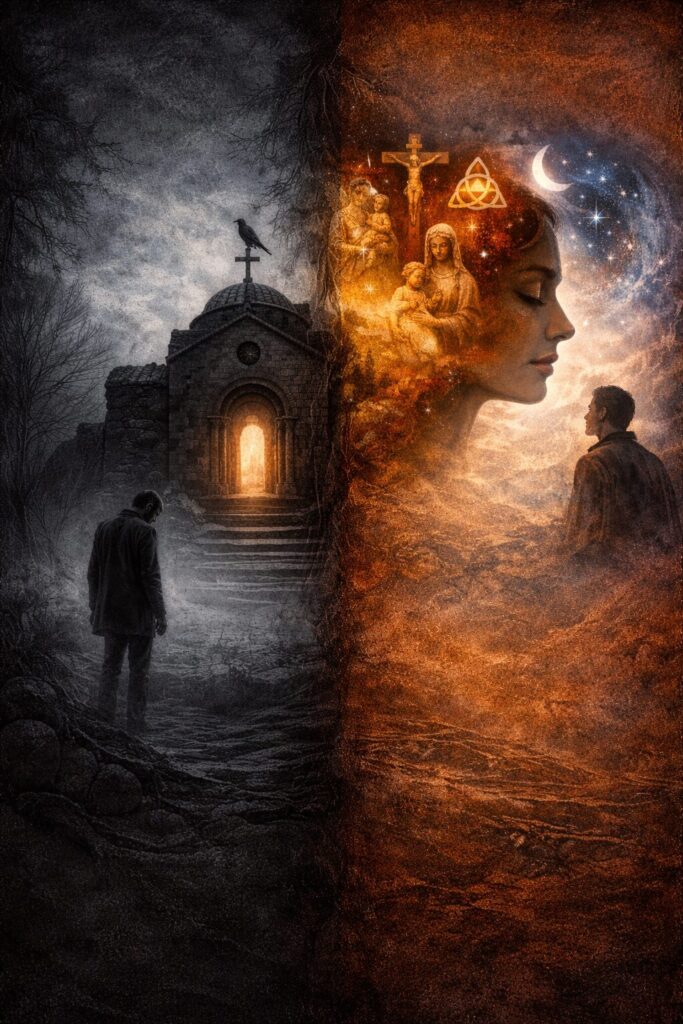
Carl Gustav Jung, however, viewed religious dogmas from a completely different perspective. For him they were not primarily authoritarian teachings or theological definitions, but symbolic expressions of the deepest experiences of the soul. In this view, dogmas are not merely statements about God or metaphysical realities; they are at the same time mirrors of the human soul.
A large part of human psychic life is not rational. Dreams, visions, myths, and religious images arise from those deeper layers of the psyche that we call the unconscious. In these regions archetypal images emerge, images that reappear in religions, myths, and cultural symbols throughout history.
Religious dogmas are therefore not accidental constructions of theological systems. Rather, they are the result of a long historical process in which humanity has attempted to give its deepest inner experiences an understandable symbolic form.
In this sense, dogmas are cultural vessels of psychic truth.
Dogma as a Symbolic Form of Knowledge
Modern rationalism recognizes only those forms of truth that can be logically explained or empirically verified. Yet the human psyche extends far beyond the realm of rational thinking. Feelings, images, intuitions, and unconscious impulses play an equally important role in human life.
Many of the most fundamental human experiences—such as encounters with meaning, guilt, redemption, wholeness, or transcendence—cannot be fully expressed in abstract concepts. They appear instead in symbols.
A symbol refers to something that cannot be fully grasped conceptually. It connects different levels of experience and always contains a surplus of meaning.
Dogmas are therefore highly developed symbolic formulations that have emerged over long periods of time. They attempt to describe experiences that lie at the boundary between consciousness and the unconscious.
Precisely because they include both the rational and the irrational, both the conscious and the unconscious, they possess a particular depth. While purely rational worldviews tend to exclude everything that cannot be logically explained, religious dogmas preserve those dimensions of reality that can only be expressed symbolically.
In this sense, Jung believed that dogmas are in some respects more complete than purely rationalistic worldviews, because they take into account the full reality of human psychic life.
Dogma as Help in Confronting the Unknown
The human psyche contains vast regions that remain hidden from conscious thought. These areas of the unconscious can be both creative and unsettling.
Human beings are therefore constantly confronted with the unknown within their own soul. Dreams, visions, powerful emotions, or existential crises bring them into contact with forces that cannot be fully controlled.
Religious dogmas help human beings to deal with this unknown. They provide symbolic orientation and prevent individuals from being overwhelmed by the unconscious forces of their psyche.
In this sense, dogmas function like psychic maps. They offer images and ideas through which people can interpret experiences that might otherwise appear chaotic or meaningless.
In this way they protect human beings from a loss of meaning.
Archetypes and the Collective Unconscious
A central concept in Jung’s psychology is that of the archetype. Archetypes are fundamental structures of the psyche that are common to all human beings. They belong to the collective unconscious, that deep layer of the psyche that does not arise from personal experience but forms part of humanity’s shared psychological inheritance.
Archetypes appear in dreams, myths, fairy tales, and religious imagery. Examples include:
- the divine father
- the great mother
- the hero
- the divine child
- the shadow
- the wise old man
Religious dogmas can therefore be understood as historically developed expressions of such archetypal images.
The Trinity as a Psychological Symbol
A particularly interesting example of Jung’s interpretation of religious dogma is the Christian doctrine of the Trinity—the conception of God as Father, Son, and Holy Spirit.
The Father represents the principle of order, law, and spiritual authority.
The Son symbolizes the connection between God and humanity and can psychologically be understood as an expression of the Self.
The Holy Spirit represents the living experience of the divine within the soul.
However, many symbolic systems of humanity are not based on a triad but on a quaternity. Four directions, four elements, or four psychological functions often form a structure of wholeness.
For this reason, Jung suspected that a fourth element is missing in the Christian symbolic system.
The Missing Fourth: Shadow, Matter, and the Feminine
This missing element lies in those aspects of reality that traditional Christian thought often excluded—particularly matter, the feminine, and the darker side of existence.
Psychologically this corresponds to the shadow, those parts of the personality that the individual represses or denies.
Jung therefore saw a possible completion of the Trinity in a quaternity, which would include both matter and the feminine.
He interpreted the Catholic dogma of the Assumption of Mary as a symbolic step in this direction.
The Virgin Birth and the Archetype of the Divine Child
Jung also interpreted the dogma of the Virgin Birth symbolically.
The birth of a divine child from a pure mother is an archetypal motif that appears in many cultures.
This motif refers to the archetype of the divine child, which symbolizes the possibility of inner renewal and wholeness.
Dogma and Psychic Hygiene
Jung also viewed religious symbolic systems from the perspective of psychic hygiene.
The human psyche requires a certain inner order, just as the body requires physical hygiene. Without such order, the forces of the unconscious can become chaotic or destructive.
Religious symbols and dogmas give these forces a symbolic form and a cultural structure. In doing so they help maintain the balance between consciousness and the unconscious.
Jung therefore regarded religious symbolic systems as a form of collective psychic hygiene of culture. They allow human beings to confront the deep forces of their own psyche without being overwhelmed by them.
The Living and the Dying Symbol
Religious dogmas remain effective only as long as they remain living symbols.
When their symbolic meaning is lost and they are repeated only mechanically, they become empty formulas.
Yet the archetypal forces do not disappear. They seek new expressions—often in ideologies, political movements, or collective projections.
Without Dogma No Soul
The soul requires symbolic forms in order to understand itself.
Dogma is one such form. It is a mirror of the soul, in which the archetypal structures of the human psyche can be recognized.
In its symbols, human beings encounter the deepest forces of their own unconscious.
The Modern Soul and the Loss of Symbolic Language
The modern world has produced an enormous expansion of rational knowledge. Science and technology have given humanity a level of control over external nature that earlier generations could scarcely have imagined. Yet this progress has also altered humanity’s relationship to its own inner world.
The symbolic language through which earlier cultures expressed their psychic experiences has largely been lost. Myths, religious images, and dogmas now appear to many modern individuals as mere historical remnants or naïve ideas of the past.
But when this symbolic language disappears, what it once expressed does not disappear.
The archetypal forces of the psyche remain active. Human beings still carry within themselves those deep experiences of meaning, guilt, redemption, wholeness, and transcendence that once found expression in religious symbols.
If no cultural forms exist to contain these experiences, disorientation and inner emptiness easily arise.
This is one of the central crises of modern culture. Humanity has learned to master the external world, yet it has often lost access to the symbolic images of its own soul.
The task of modern culture is therefore not to abolish the symbolic language of religion, but to understand it anew.
For as long as human beings possess a soul, they will also need symbols in order to understand that soul.
The loss of symbolic language is therefore not merely a cultural problem; it is a problem of the soul itself.
Where no symbols remain, the unconscious either falls silent or speaks in chaotic forms.
And for this very reason the statement gains its deepest meaning:
Without dogma, there is no soul.