Infant Jesus – The Christ Child – The paradox of the Christ Child in the collective unconscious
The Christ Child – Smaller than small, Greater than great!
The symbol of the Christ Child is far more than a religious narrative or a sentimental image at Christmastime. The Christ Child literally embodies the purest paradigm of a universal, disproportionately powerful primal image: the archetype of the child. It symbolizes the suffering yet redemptive journey of the human soul from fragmentation to wholeness.


Power of pure suffering, of mystical love that destroys evil at its root and creates the child Jesus in the very foundation of the soul, even when the world burns!
The Infant Jesus – Archetype of the Child Goddess
Anyone wishing to understand the symbol of the Infant Jesus on a spiritual level must move beyond a purely historical-religious perspective, for these are autochthonous re-emergences beyond all tradition. The archetypes – such as the child or the child god – are not acquired or invented concepts, but rather innate, inherited structural elements of the human soul, originating from the unconscious ground of the soul, the collective unconscious. They exist completely independently of culture and era and function like the morphological organs of our biological body.
The Preconscious Twilight State of the Soul
One can draw a direct parallel between the modern psyche in states of reduced intensity of consciousness and the mental state of primitive peoples (“primitives”).
The primitive mind is characterized by the fact that the ego consciousness is only weakly developed in extent and intensity. Psychological functions such as will and logical thinking are not yet differentiated: the primitive person does not think actively, but “it thinks within him”. The spontaneity of the psychological act does not lie with the conscious ego, but with the overwhelming unconscious.
This leads to a fundamental insight: primitive peoples do not invent myths - they experience them as involuntary, vital revelations of the preconscious soul. These myths are not idle intellectual allegories, but they represent the actual spiritual life of the tribe. If this mythical ancestry is lost, the tribe morally disintegrates and perishes like a person who has lost his soul. True religion is therefore to be defined as the living, reverent relationship to these autonomous, unconscious processes in the dark background of the soul (collective unconscious), which elude any conscious arbitrary control.
The Hermeneutic Principle: The "As-If"
An archetype can never be rationalistically "explained," mathematically defined, or completely resolved by the scientific intellect. The intellect regularly lapses into Enlightenment-era pretensions and attempts to reduce myths to purely concrete factors. An archetype is a psychic organ, like the cerebellum or the kidneys. It can be described anatomically and through historical comparison, but it cannot be explained away without risking a severe neurosis.
Archetypal content speaks, in principle, in the language of allegory. When a myth speaks of the sun and identifies it with a lion, a king, gold, or life force, it ultimately refers to none of these physical objects. It describes an unknown, ineffable third element that will always remain a thorn in the side of the intellect because it cannot be forced into rational formulas.
Every legitimate psychological interpretation must be aware that it necessarily remains in the realm of "as-if." While the innermost core meaning can be circumscribed through comparative imagery, it can never be fully described. A truly healing explanation must be such that the archetype's functional, vital significance for the psyche remains intact and a viable, reverential connection to consciousness is ensured.
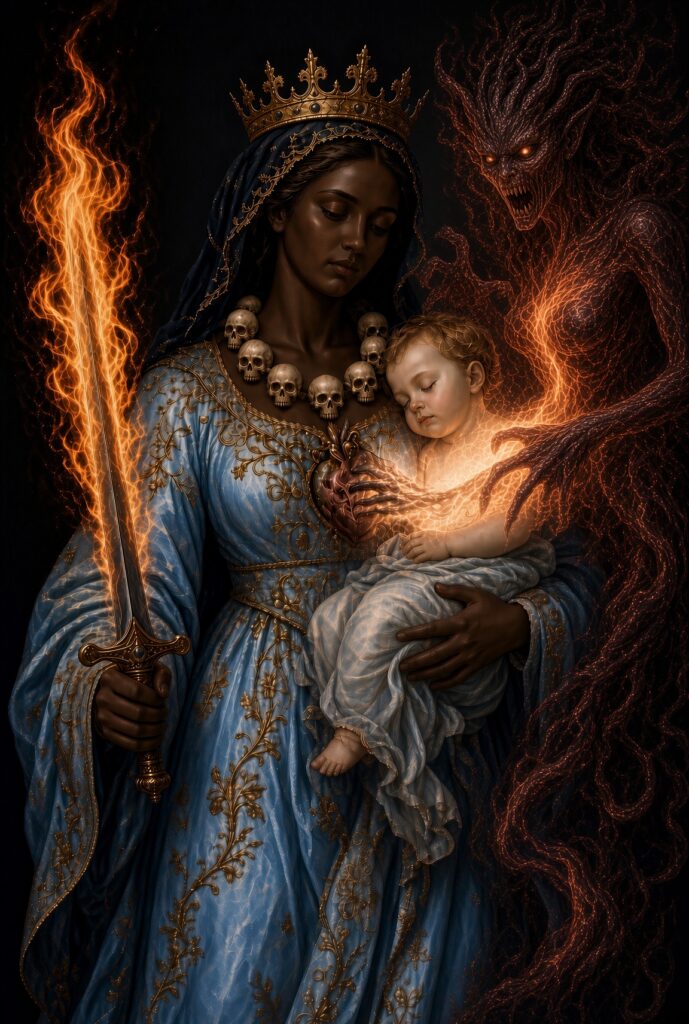
The Functional Psychology of the Infant – Compensation and Vitality
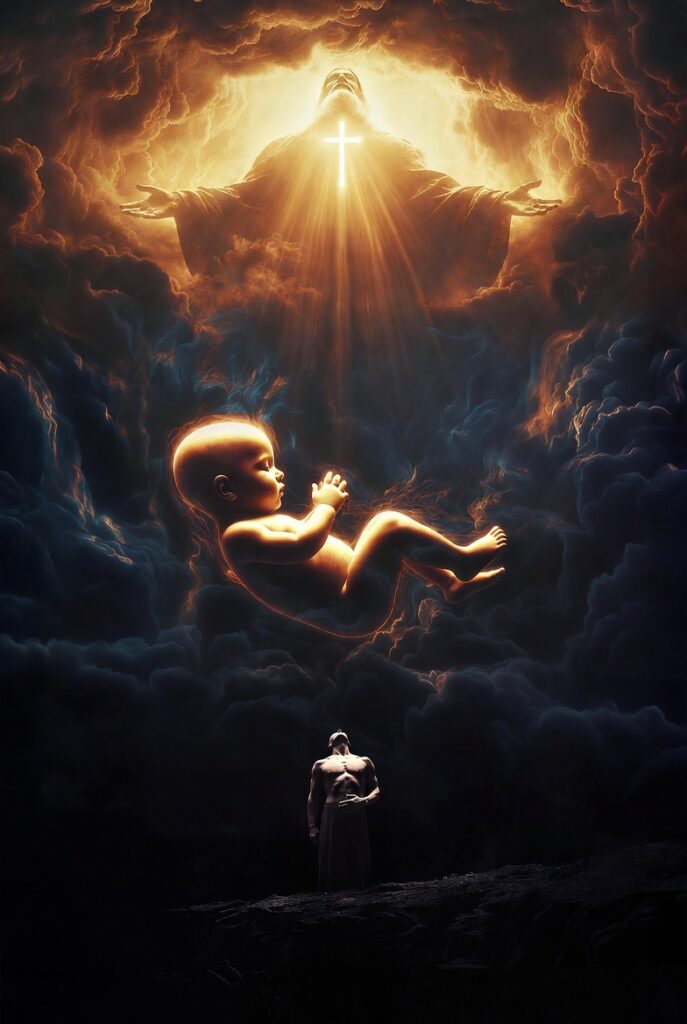
In depth psychology, the child motif is far more than a sentimental reminiscence of one's own personal childhood. It is defined as the image for the preconscious childhood aspect of the collective psyche.
The highly differentiated consciousness of modern, civilized humans is constantly threatened by a dangerous uprooting due to the enormous dynamics of the will. In order to sharply focus on goals and function socially, the ego must rigorously exclude other, equally proven psychic contents. This exclusion inevitably creates an extreme one-sidedness of consciousness. The ego violently separates itself from its biological foundations in favor of an artificial mask (persona) that corresponds to its ambitions.
With this progressiveness, humanity accumulates a gigantic, Promethean debt, which periodically discharges in fateful catastrophes. The further we distance ourselves from our root state, the more helplessly we succumb to collective suggestions and psychic epidemics.
The Child as Compensation for the Rational Ego
At this critical juncture, the child archetype intervenes as a currently functioning, compensatory regulatory system. It corrects and remediates the extravagances of consciousness by forcing a confrontation with the original, instinctual truth. From the perspective of rational progress, this dynamic is often labeled with pejorative terms such as inertia, backwardness, conservatism, or anxiety.
In truth, however, this retarding ideal of the child is faithful to the traditional law of nature and protects the psyche from the convulsive self-destruction of total uprooting.
The Life Force and the Symbol of the Self
The child is not merely a retrospective, but essentially a potential future. Life is a continuous flow forward; its appearance in dreams, visions, or imaginings therefore anticipates a future, profound transformation of the personality. It prepares the ground for that higher form which emerges from the synthesis of conscious and unconscious personality elements.
Since this potential for wholeness in the human psyche is inherent a priori from birth, the Aristotelian concept of entelechy is used to describe it. The child is a symbol that unites opposites, a mediator, a redeemer, and a whole-maker. Because it embodies this wholeness that transcends consciousness, the motif of the child is phenomenologically interchangeable without limit with geometric and material symbols of wholeness. It often manifests in psychological experience as a circle, sphere, mandala, quaternary (fourfold) form, gemstone, pearl, or golden egg.
The Infant Jesus – The Miraculous Birth and the “Irrational Third”
In Christian mythology, the infant Jesus is brought into the world through a miraculous, virginal birth – without the intervention of a biological father, conceived by the Holy Spirit. Psychologically, this non-empirical conception is interpreted as the precise description of a creative psychic experience, which involves the emergence of a completely new, as yet unrecognized content.
When an individual finds themselves in a painful, blocked conflict situation, there is no way out for logical consciousness; the law of tertium non datur (there is no third option) applies. However, from the immense clash of these irreconcilable opposites, the unconscious psyche creates an irrational third option. This new symbol corresponds neither to the “yes” nor the “no” of the conflict and is therefore initially rejected and despised by both sides of consciousness.
The birth in the humble, impoverished stable in Bethlehem, isolated from society, reflects this psychological reality: The redemptive impulse is initially misunderstood by the rational mind as utterly helpless, marginal, and meaningless.
The Paradox – Smaller than small and greater than great
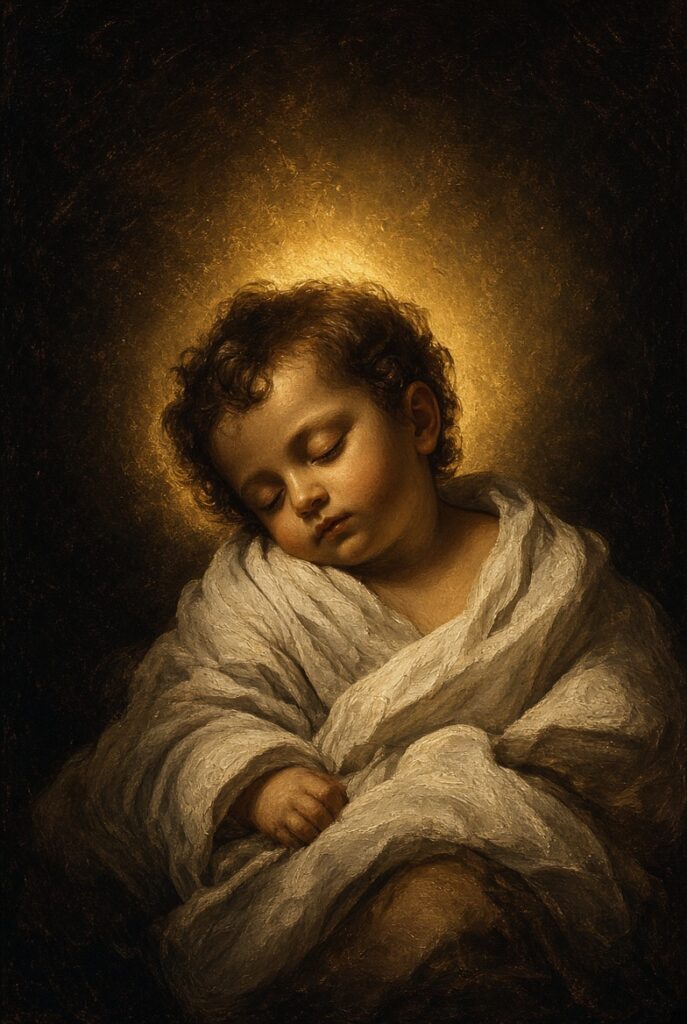
The Christ Child embodies the fundamental paradox that runs like a thread through the fate of all child gods: He is simultaneously utterly powerless and omnipotent.
- Smaller than small: The newborn in the stable is defenseless, persecuted by Herod's Massacre of the Innocents, and forced to flee into a foreign land. This describes the precarious psychological possibility of wholeness in everyday life. The new content is easily overlooked by the ego and constantly threatens to be swallowed up again by the unconscious background (horror vacui).
- Greater than great: At the same time, this child possesses powers that far surpass all human measure; he is the ruler of the cosmos and the bringer of a new era.
This duality is directly linked to Indian speculation on the Atman principle and the self. The self, as an individual, punctual phenomenon in the here and now, is "smaller than small." As the absolute opposite and equivalent of the entire world, however, it is "greater than great." It is this psychic otherness, the inescapable conditio sine qua non, that makes consciousness possible in the first place through the separation of subject and object. It personifies life forces far beyond the limited scope of the ego.
The Legend of Saint Christopher: The Burden of the Unconscious Self
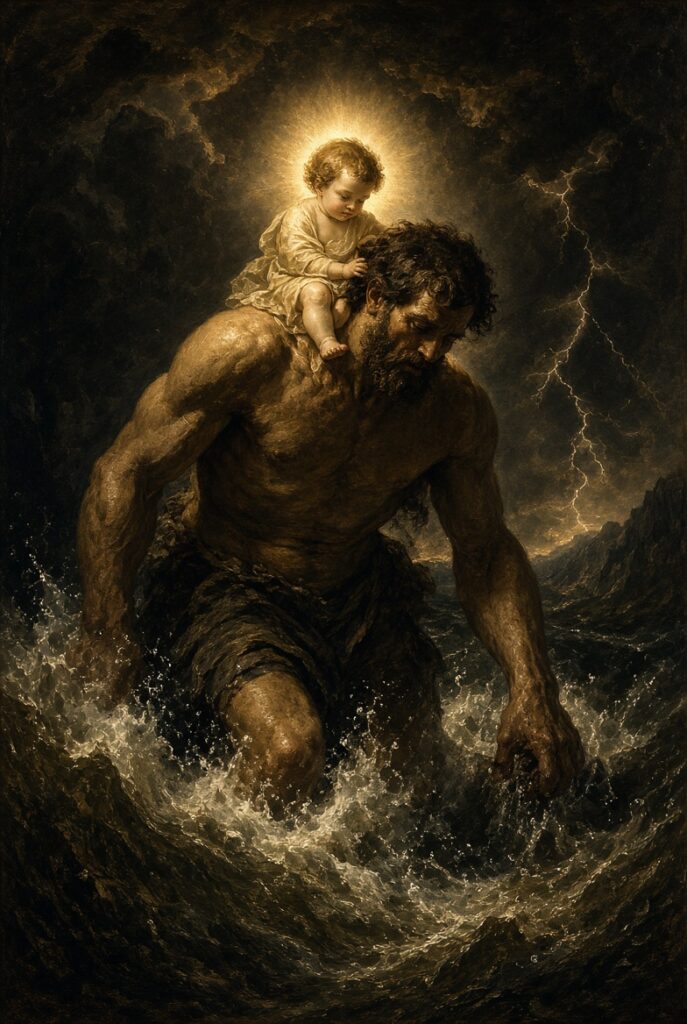
As a psychologically brilliant key to understanding the power of this archetype, we cite the legend of Saint Christopher, which is closely intertwined with the aspect of the Christ Child.
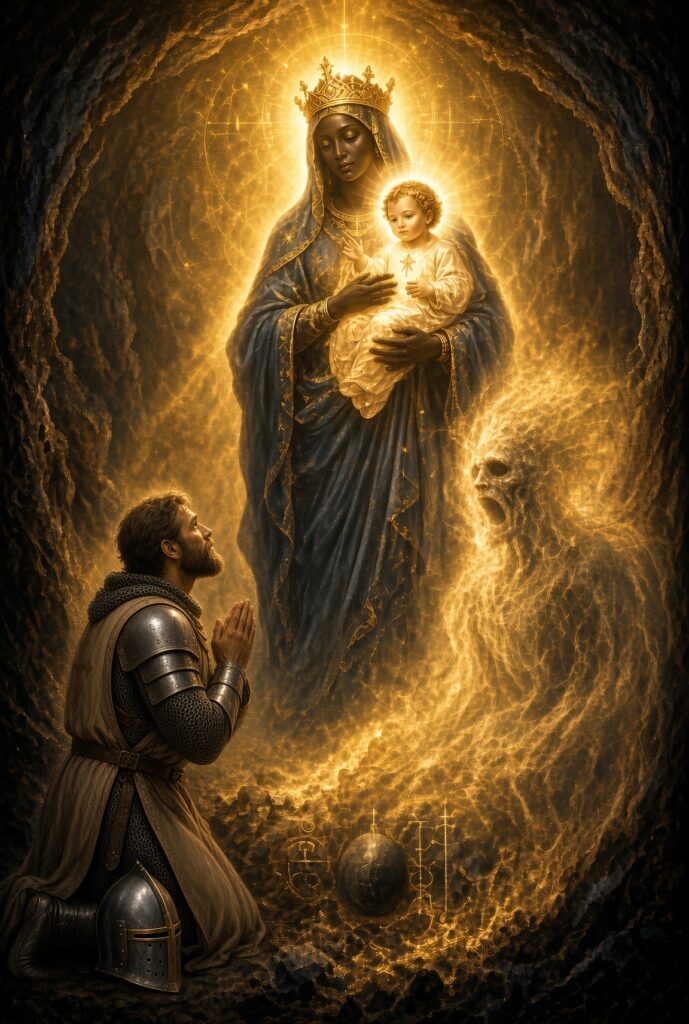
The giant Saint Christopher carries a seemingly feather-light, unsightly little child on his shoulders to transport it across a raging river. However, the deeper he wades into the water—the classic symbol of the unconscious—the heavier, more massive, and more unbearable the burden becomes. In the end, the giant is in danger of drowning under the weight, as he feels he is carrying the entire weight of the world on his shoulders.
This image illustrates the painful process of becoming psychically conscious: A content that the ego initially dismissed as a 'small, harmless child' reveals itself, upon deeper contact with the instinctual layers of the psyche, as the overwhelming totality of the self. The self is almost crushed under the weight of responsibility, but it is precisely through this suffering that it undergoes its final transformation.
The Four Structural Categories of the Phenomenology of the Christ Child
The complex manifestations of the child must not be conflated. Phenomenology can be systematized into four precisely distinguishable categories, which have found their complete, collective expression in the Christian faith:
Abandonment, Exposure, and Vulnerability:
- Psychological Background: Describes the painful experience when a new psychic content is split off from consciousness and isolated. Abandonment, however, is not a passive accident, but the necessary condition for detachment from the origin. The child cannot grow without separating from the unconscious identity with the mother.
- Christ Symbol: The birth in the exceptional state of the stable, the solitude of the manger, and the immediate threat from Herod's henchmen.
The Invincibility of the Child:
- Psychological Background: The child represents the strongest, most fundamental, and most inescapable drive of human nature—the natural compulsion toward self-realization. It is a "cannot be otherwise" inherent in the laws of nature, equipped with all instinctual forces, against which the ego's frantic will is ultimately powerless.
- Christ symbol: The defenseless child triumphs over the cunning attacks of the powerful kings; the fragile manger proves more stable than the ruler's throne.
Hermaphroditism (dualism):
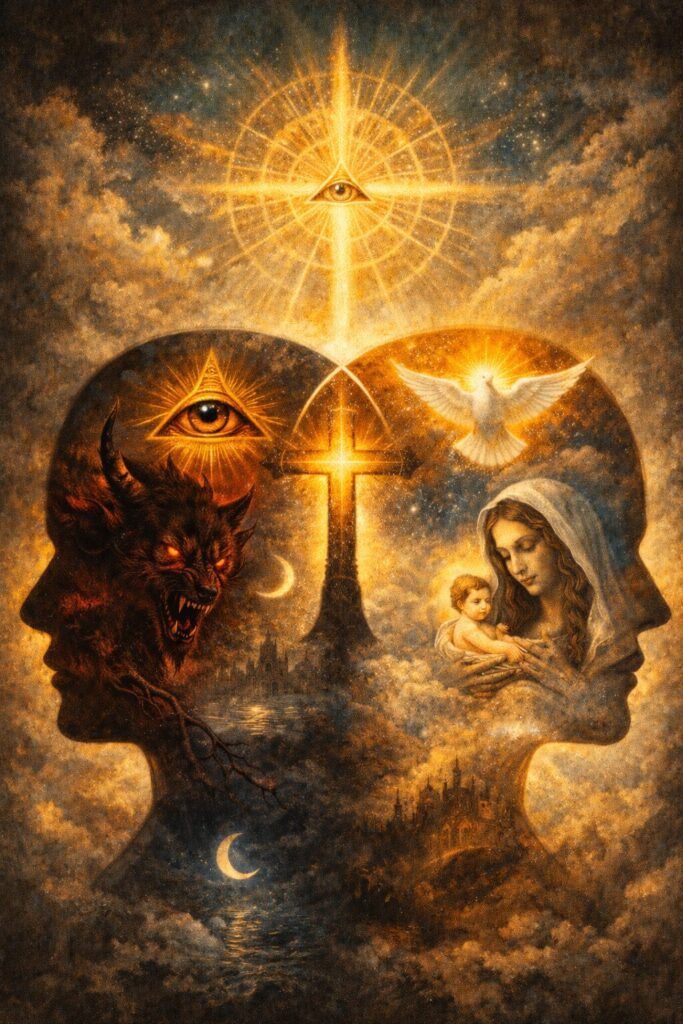
- Psychological background: The majority of cosmogonic child gods are dual-sexed (cf. the alchemical Rebis or the filius sapientiae). This is not a relic of primitive primitiveness, but a highly developed symbol that unites opposites. It connects consciousness with the unconscious. Since the unconscious possesses feminine qualities in men (anima) and masculine qualities in women (animus), the child's androgenic character bridges the gap between the sexes of the psyche.
- Christ symbol: The pronounced idea of Christ's androgyny in Catholicism and mysticism, in which Christ is meditated upon as the perfect fusion of the divine Logos and feminine Sophia (wisdom).
The beginning and end being:
- Psychological background: The child symbolizes the preconscious being (the state before the emergence of self-awareness in early childhood) and simultaneously the postconscious being (an anticipation by analogy beyond death). The "eternal child" (puer aeternus) expresses that the psychic wholeness always encompasses and guides the temporally and spatially limited self.
- Christ symbol: The theological definition of Christ as the "Alpha and Omega"—the firstborn before all creation, the cosmic child who returns at the end of time as the judge of the world.
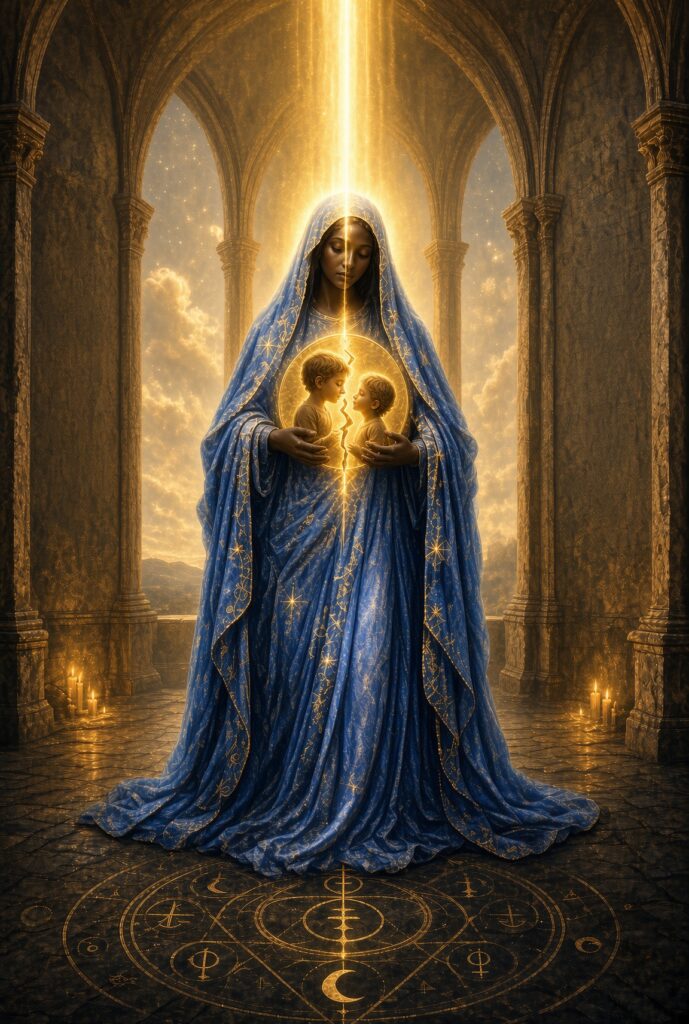
The Transformation Process
The archetype is not an abstract theoretical construct, but a dynamic, often painful experiential process that unfolds in four typical stages:
Stage 1: Personal Infantilism
The student initially encounters the archetype in a completely unconscious and unreflective form. The ego is blindly identified with its personal infantilism. Phenomenologically, this manifests as the neurotic image of the "abandoned," misunderstood, and unjustly treated child. Paradoxically, this child is characterized by excessive, presumptuous demands on its environment. The individual remains in a chronic, regressive victim mentality and demands from partners or the master the unconditional nourishment and reparation that it lacked in its actual childhood.
Stage 2: Objectification and Mythologization
Under the influence of therapeutic meditation (through dream work and the method of active imagination), a gradual separation and dissolution of this rigid identity begins. The child is lifted out of the narrow confines of its personal biography and objectified as an autonomous, impersonal element of the collective soul.
In this stage, the archaic and mythological features become visible in the student's material: The dreamed child suddenly appears with exotic or dark skin, appears cosmically among the stars, hatches from a golden egg, or assumes theriomorphic features (appearing as a snake, crocodile, or monkey). The student recognizes, with both shock and relief, that their personal trauma is linked to a transpersonal, universally human primal theme.
Stage 3: The Epiphany of the Hero and the Danger of Inflation
The subsequent course of transformation corresponds exactly to the structure of the hero myth. The defenseless child transforms into the adolescent hero, whose main deed is the overcoming of the monster of darkness (the victory of consciousness over the consuming unconscious). Here, however, lurks an acute pitfall, highly detrimental to psychological equilibrium: the phenomenon of psychic inflation. The ego fatally confuses itself with the attractive hero role:
Positive inflation: The ego succumbs to a spiritual or intellectual megalomania. It is absolutely convinced of being something truly special, possessing an exclusive, redemptive mission, or embodying the "child of Jesus" within itself.
Negative inflation: Unconscious arrogance is compensated for by the conscious staging of the "heroic sufferer." The student neurotically revels in the imperturbability and uniqueness of their own gigantic suffering. Conscious megalomania and unconscious inferiority form an inseparable unity here.
Stage 4: The Shift of the Center into the Self
Only when this perilous precipice of second identification is successfully navigated can conscious processes be clearly separated from unconscious ones, and the unconscious observed objectively. A genuine confrontation and ultimately a synthesis of the conscious and unconscious elements of perception and action occur. Ego-consciousness is painfully, but liberatingly, reduced to its true, relative human scale.
This results in the final shift of the personality's center from the ego to the Self. The ego recognizes profoundly that it is not the absolute master in its own house, but rather a satellite orbiting the transcendent, unifying center of the entire psyche. The individual experiences the psychological, experiential reality of that great mystical formula which, in the Christian context, states:
It is no longer I who live, but Christ—the eternal Christ Child—who lives in me.
The Eternal Infant as Salvation for the Mind
The Christ Child in the collective unconscious is not an infantile state that we should intellectually leave behind or erase in the course of growing up. If we succeed in combining the mature, rational responsibility of adulthood with the indomitable, future-oriented transformative power of the Christ Child archetype, we attain true psychological wholeness. Progress forced purely by willpower always remains a strained, neurotic act that leads to catastrophe. Only the courageous acceptance of this inner symbol restores to us that deep primal trust that even from the seemingly most unsightly, abandoned, and vulnerable beginnings of our lives, an infinitely vast, indestructible new consciousness can emerge.
The Infant Jesus – Smaller than small, greater than great!
Dear brothers and sisters in spirit, the child in the manger is not a feeling and not merely a story. It is an organ of the soul. Whoever explains it away wounds this organ. In the Christ Child, the archetype of the child appears in its clearest Christian form: the path from fragmentation to wholeness under the Logos, borne by Sophia.
Myths are not invented. They are experienced. Religio is the bond to this foundation. The modern self is sharp and uprooted. The child corrects this one-sidedness—not as nostalgia, but as fidelity to the law of nature and as a future that the self cannot create. The soul is more than the self.
The virgin birth proclaims: A new third element emerges where reason allows none. The stable is this contempt in imagery. Smaller than small: defenseless, persecuted. Greater than large: master of the cosmos. Christopher carries a light child across the river. The deeper he descends, the heavier the burden becomes. What seemed harmless is the self.
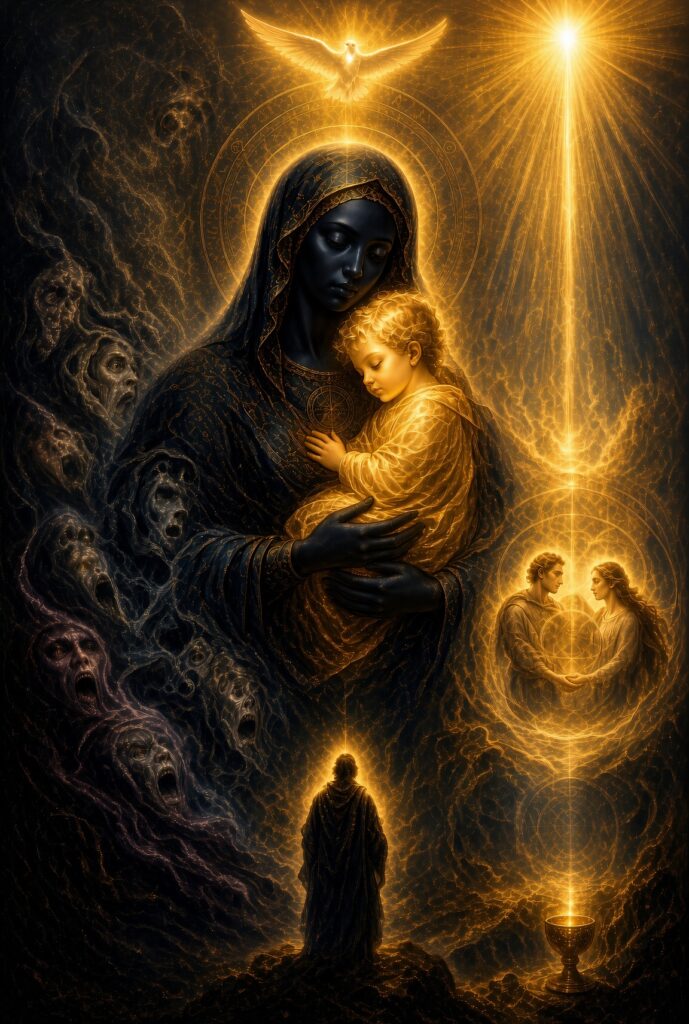
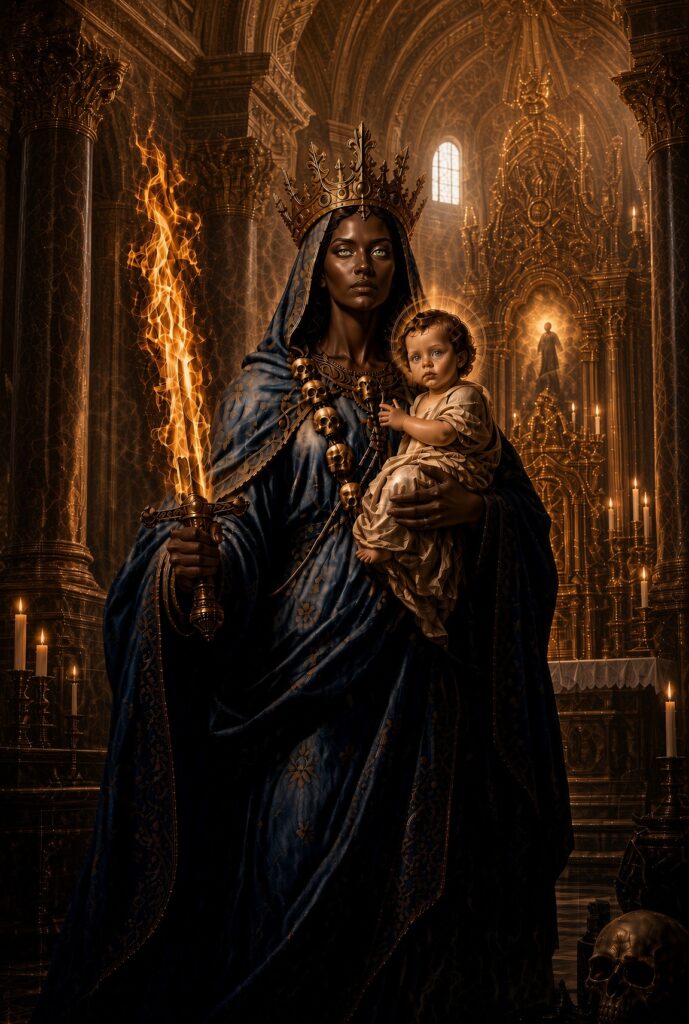
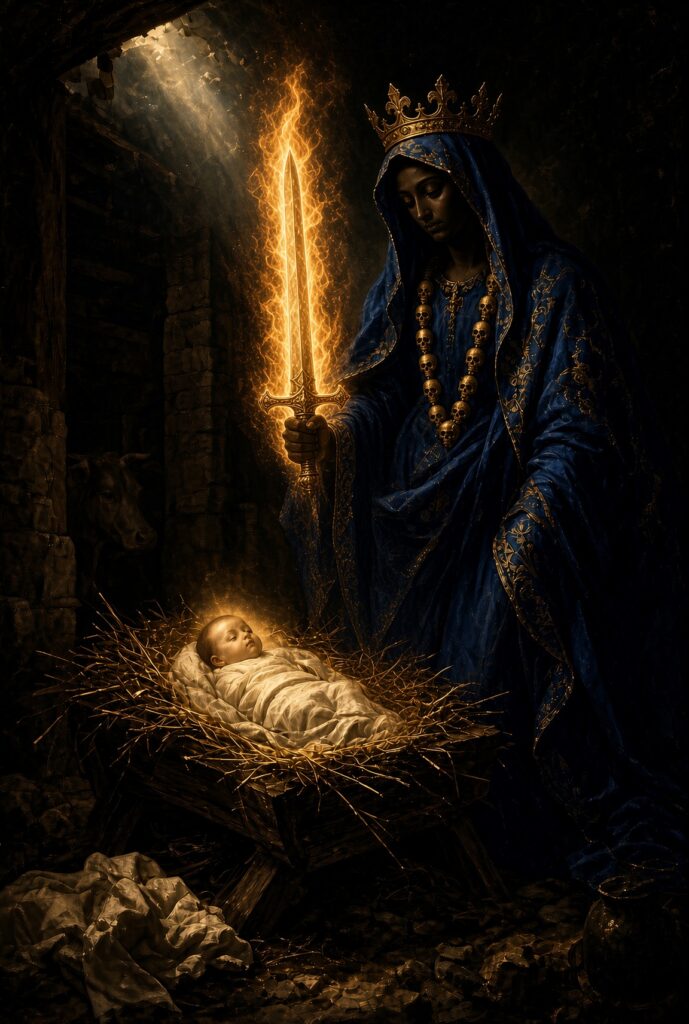
Four figures, one path: detachment from the mother. The manger is firmer than the throne. Logos and Sophia—the Black Madonna as a dark foundation that bears the word and does not devour it. Alpha and Omega.
At first, the ego sees itself as the wounded child. Then the image transcends the personal. Then inflation threatens: chosen one or sufferer. If the precipice is navigated, the ego revolves around the center. No longer do I live, but Christ lives in me. This is not a return to the mother. This is a turning back to the Father.
Those who only want remain tense. Those who remain only children remain immature. Carry the child through the river. The burden makes the man. Intuition supports the word; it does not replace it. Love is the union of healthy femininity and healthy masculinity. The sword slays the infantile claim and awakens the soul.
Smaller than small. Greater than great! Those who hold both stand in the mystery of the manger.