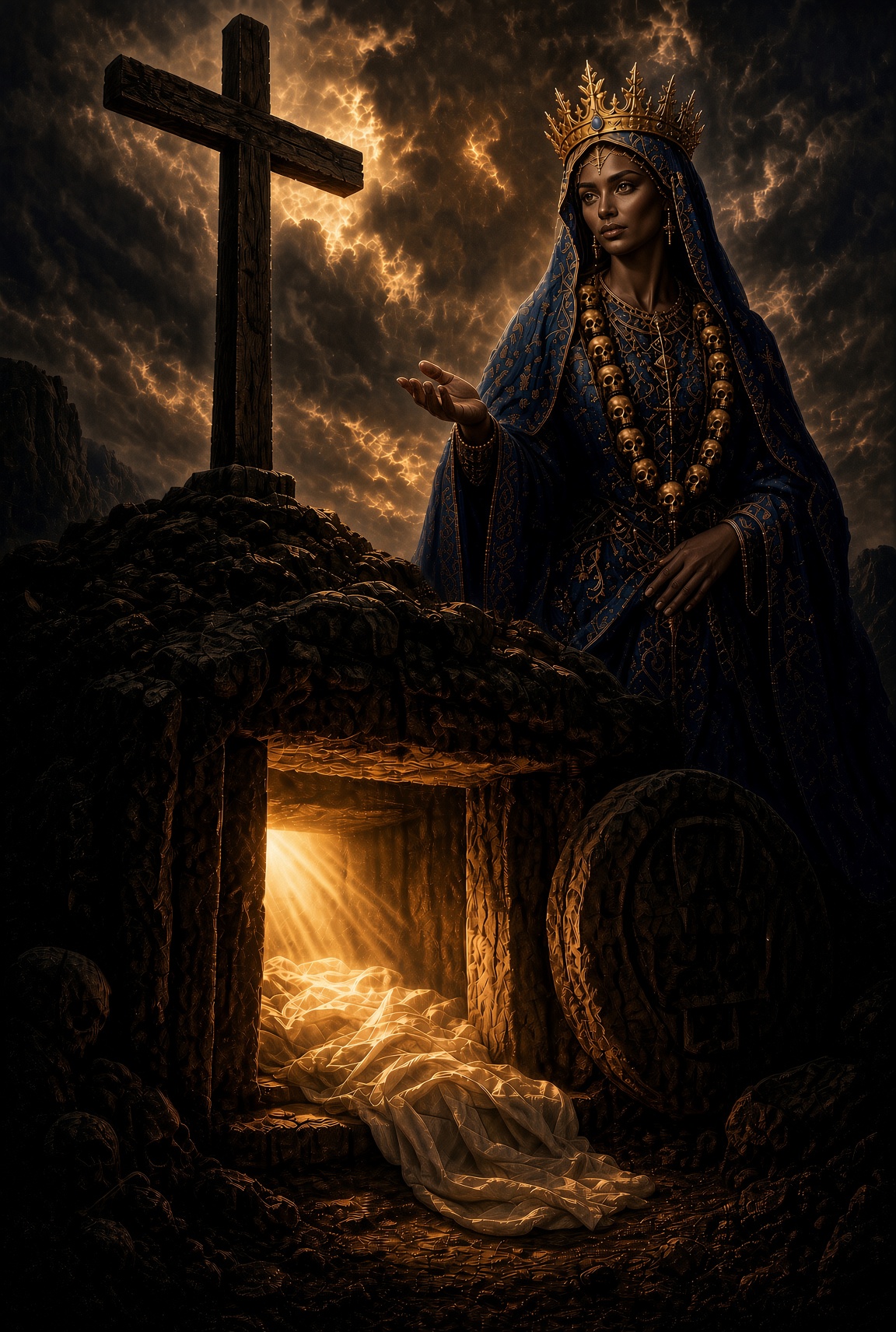
The Death and Resurrection of Christ – The Word of Reversal of the Logos and the Liberation of the Soul
Dear brothers and sisters, in the dark hour of Nigredo, that stage in which the soul descends into darkness to be purified and reborn, the mystery of the cross and the empty tomb is revealed. A fivefold contemplation of the death and resurrection of Christ unveils that this is more than a historical event. It is the archetypal pattern of spiritual individuation, the living word of reversal that simultaneously kills and gives life. It is the call to conversion to the symbolic Father in Heaven, to the rediscovery of the divine Logos, and to the healing union of healthy masculinity and healthy femininity—that Sophia who appears in the Black Madonna as the dark, wise mother of the soul and shows the way to true womanhood. In what follows, we will unfold this mystery in detail so that it may not only be understood but also lived in the depths of the soul.
The Nature of Experience – Place of Things and Forum of Action
The world appears to humankind in two ways. First, as the place of things: objective, measurable, subject to the gaze of science. Second, as the forum of action: a space of values, meaning, and decision. Scientific observation is useful and necessary, yet it remains subordinate to deeper meaning. For humankind is not merely an object among objects. We are beings of action who need direction, who must choose between chaos and order.
The forum of action is primary. It finds its expression in myth, ritual, drama, and narrative. Here, the "is" is complemented by the "ought." The Christian narrative is not an ordinary story that leads from point A to point B. It is the revolutionary story: the intrusion of the unexpected that causes the old to die and gives birth to the new. In this dying begins the Nigredo – the dark phase of the soul, in which old ideas, comfortable lies, and bitter resentments must be consumed. Only those who are willing to let go of what is inadequate can make room for the Logos, which creates order out of chaos.
The Axioms of Christian Conversion
The Christian revolution rests on clear axioms that order the life of the soul:
First: Being is good—despite all tragedy and wickedness.
Second: Therefore, it is our task to work for the constant improvement of this being, and this work is love.
Third: Such work is done in truth.
Fourth: Everything inadequate may and must be burned away so that the better may take its place.
Fifth: This burning away and renewal is the holy imitation of Christ.
Sixth: Although the sacrifice of Christ has redeemed all, work remains incumbent upon humankind.
Seventh: This work is the sacred purpose of life.
Eighth: Thus, we strive toward the heavenly city on the hill.
These axioms are not mere statements. They are the sword of the Logos, which awakens the soul and simultaneously slays whatever within it stands in the way of truth. They call for repentance—not a fleeting emotional reaction, but a lasting realignment with the symbolic Father in heaven.
Sacrifice and Narrative—The Path of Postponing and the Death of the Old
At the heart of the Christian narrative lies sacrifice. Humanity discovers the future by surrendering the present. Work is deferred gratification. True sacrifice is the surrender of what is most precious to us so that something greater may emerge.
The great narratives illustrate this path: the fall from paradise, which brings the realization of death and vulnerability; Cain and Abel, for whom the right sacrifice makes the difference between acceptance and rejection; Abraham, who is willing to offer what he loves most; and finally, the cross, on which the son gives himself. Not all sacrifices are the same. Only that which is offered from a pure heart and in truth opens the way. The highest sacrifice is the voluntary acceptance of one's own cross—the acceptance of vulnerability, ignorance, and death.
Here, alchemical wisdom intersects with the doctrine of individuation. The soul must let the old die so that the new can be born. Whoever clings to what is already dead—to old enmities, to convenient lies, to bitterness—remains trapped in Nigredo. Whoever lets go receives the light of resurrection. This letting go is courage. It is the decision to follow the Logos, which calls order out of chaos.
The Ark, the Dome, and the Cross—Bridge Between the Finite and the Infinite
The Ark of the Covenant was the sanctuary of Israel: a golden shrine that housed the tablets of the Law, the staff, and the manna. It was the bridge between the finite and the infinite, the visible and the invisible. Around it, the community was organized. It was not to be touched, for it bore the axiomatic, the inviolable.
In the Christian tradition, this bridge becomes the cross and the cathedral. The cross is the site of transformation. Here, the Logos accepts death and transforms it. Christ rejects the kingdoms of this world and chooses the Kingdom of God. He speaks the truth that creates order out of chaos. The cross becomes the sword that slays bitterness and revenge and awakens the soul to life.
The cathedral embodies this spirit in stone and ritual. In the Eucharist, following Christ becomes tangible: We let the old die and receive the new into ourselves. Here, the soul becomes the bridge between heaven and earth. Here, conversion to the Father takes place—not as an abstract idea, but as a living reality.
The psychological and spiritual significance of death and resurrection—individuation in the Logos
The resurrection is not merely a promise beyond the grave. It is the ongoing psychological and spiritual renewal: the dying of the old self and the birth of the new in every moment of truth. The Christian revolution has elevated the individual to the sovereign center—made in the image of God, called to speak truth and create order. Societies that respect this dignity flourish; those that deny it fall into tyranny and nihilism.
At the depths of the soul, this means: Individuation is the path to liberation. The soul must rediscover the Father in Heaven and break free from the false gods of comfort and resentment. Healthy masculinity bears the cross of responsibility and speaks the word of truth. Healthy femininity, symbolized in the Black Madonna and Sophia, receives and preserves life with wisdom and depth. Both unite in the love that creates wholeness—in the family of mother and father, who guide children on the path of the Logos.
Thus, the Easter mystery calls us: Let the imperfect die. Take up your cross with courage and truth. Speak the word that sets things right. Turn to the Father. Then, from the black night of the soul, the light of the resurrection will rise—not as a fleeting hope, but as the lasting reality of the good, the beautiful, and the truth. In this conversion, the soul is freed and becomes what it was from the beginning: the image of the living God.