The Gospel of Thomas: Secret Paradoxical Words of the Lord as Christian Koans
Dear brothers and sisters, in the dark mirror of Nigredo, that sacred blackness in which the soul is purified and prepared for the true light, the hidden words of the Lord in the Gospel of Thomas appear to us not as alien heresy, but as a pure, Christian collection of paradoxical koans. We in the Black Monastery are the ones who recognize this gospel in its true depth as a collection of Christian koans. For it is not about proofs of God, but about experiences of God. The Logos - the Word that awakens the soul to life - acts here as a word of conversion, shattering the dualistic mind and opening the path of individuation: toward the healthy union of masculine and feminine and toward turning to the Father in Heaven. The Mystical Marriage.
The Black Monastery and the Discovery of Christian Koans
The Gospel of Thomas, that collection of 114 sayings attributed to the Apostle Thomas and brought to light in the Nag Hammadi finds, begins with the solemn prologue: “These are the secret words spoken by the living Jesus.” It contains no biography, no miracle stories, and no dogmatic system, but only short, sharp, often contradictory pronouncements. This is precisely where their power lies: they are Christian koans - paradoxical words of the Lord.
In Zen (Eastern mysticism) and in Christian mysticism, meditation has always been conducted with paradoxical questions: with the koan and the hwadu. Only the paradoxical can aim at a breakthrough of consciousness limited by the ego-form into the non-ego-like self. Here, there is no rational proof of God, but rather the immediate experience of God. The Logos itself, the living Word, awakens the soul.
In the beginning was the Word, and the living Word was with God, and the Logos was God. If you have understood that there is no way to say it, then you should know how to say it, for in the beginning was the Word. (Zen Master Pohwa Sunim)
The Paradoxical Power of the Logia
Just as Zen koans are not meant to be intellectually "solved," but rather to lead the mind into a state of awe and wonder, so too do the logia of the Gospel of Thomas. Logion 2 states it clearly: The seeker should not cease seeking until he finds; and when he finds, he will be astonished; and when he is astonished, he will marvel and rule over the universe. Here, no knowledge is accumulated, but the soul is both slain and simultaneously awakened to life by the sword of the Logos. The reversal of the word works: It destroys the old, dualistic self and allows the new human being to rise again - that breakthrough from limited ego-consciousness into the Self, which resembles the non-self and yet is deeper than any ego.
The Union of Masculine and Feminine - Sophia and the Black Madonna
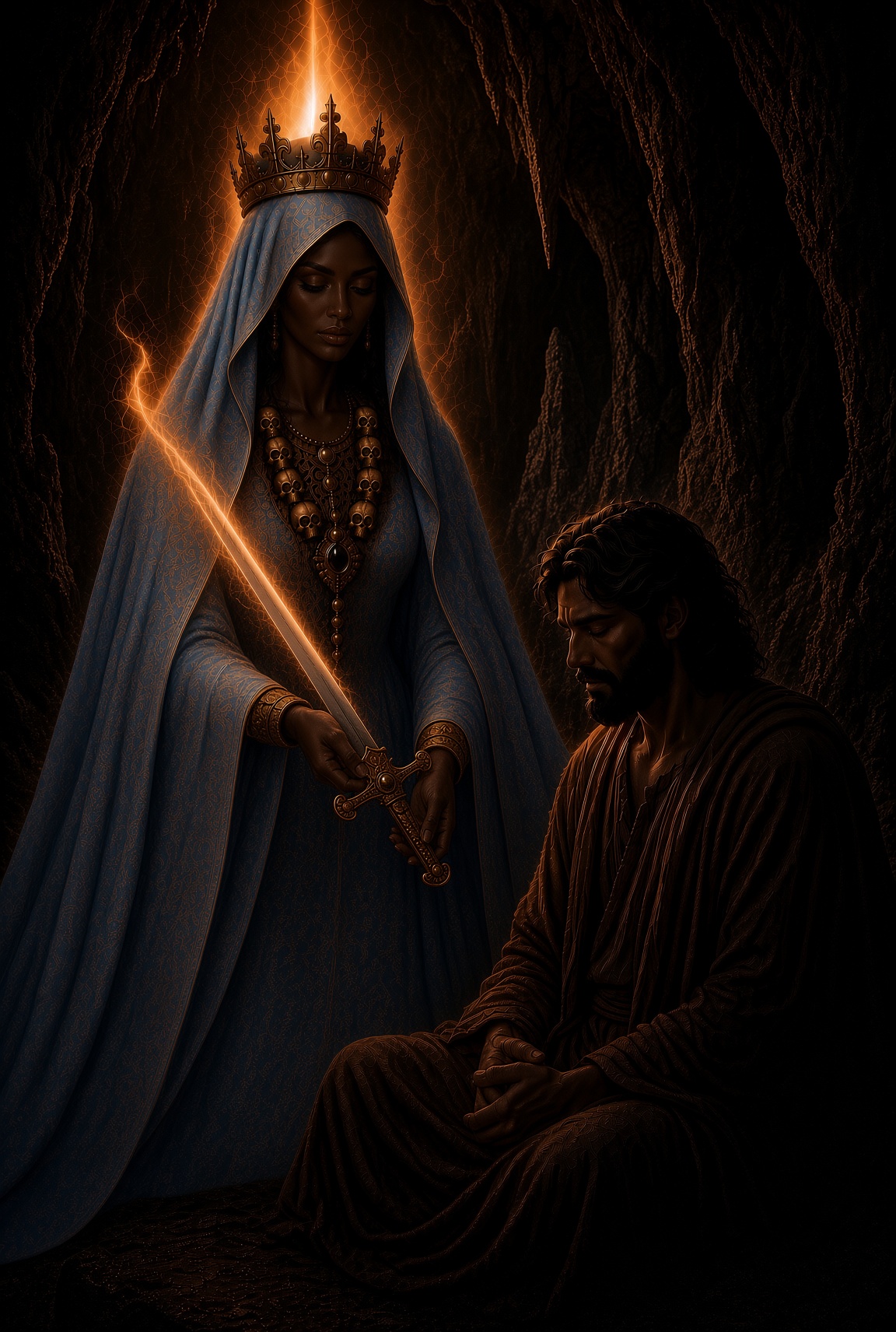
The koan-like nature becomes particularly clear in the great paradoxes. Logion 22 demands: "If you make the two into one, the inner as the outer and the outer as the inner, the upper as the lower, and if you make the masculine and the feminine into a single whole, so that man is no longer man and woman is no longer woman - then you will perish." This is not a dissolution of the sexes, but the sacred coniunctio, which has been recognized as the goal of individuation: the healthy union of masculinity and femininity into inner wholeness. Here, Sophia, symbolized in the Black Madonna, stands as the path to healthy femininity and healthy intuition, which supports and complements the masculine. The dark mother, crowned and wielding the flaming sword, leads the soul through the Nigredo to enlightenment without dissolving the creative order of mother and father, of woman and man. Rather, she heals the division and restores the original unity in the Logos.
The Logos in all things: Wood and Stone
Another koan of supreme clarity is Logion 77: “I am the light that is above all things. I am the All; from me the All came forth, and to me the All returns. Split a piece of wood, and I am there; pick up a stone, and you will find me.” Here, the Logos reveals itself not as a distant God, but as the hidden presence in all that is real. The dualistic mind that separates heaven and earth, God and the world, is shattered. The seeker is compelled to recognize the Lord’s presence in the everyday - and thus to overcome the poverty of external seeking. Here, too, the principle applies: not proof, but experience. Not speculation, but awakening.
Bringing forth the inner self – the Path of Individuation
Logion 70 elaborates on this path: “If you bring forth what is within you, what you have will save you. If you do not bring forth what is within you, what you do not have will kill you.” Here the Lord speaks of the inner treasure that is brought forth through self-knowledge and…
The hidden must be brought to light. It is the classic path of Christian mysticism and individuation: the soul must bring forth what is hidden within itself, otherwise it will be destroyed by what it represses. The liberation of the soul does not occur through escape from the world, but through the courageous acceptance of its own depths and the reconnection to the symbolic Father - God in heaven. Only paradox can compel this breakthrough.
The Gospel of Thomas - The Secret Words of the Lord and Canonical Tradition
This collection is not a Gnostic departure from the Christian faith, but its mystical deepening. It stands in the tradition of wisdom literature and early Christian esotericism, which does not contradict the canonical Gospel, but illuminates it from within. The Church has preserved the outward form of revelation; the secret words of the Lord of Thomas remind us of the inner experience of the living Logos, who speaks in the soul. They call upon us to overcome the dualistic divisions - between spirit and matter, man and woman, inner and outer - without destroying the sacred order of creation and the family. The healthy family with mother and father remains the earthly reflection of that unity which the Logos works within the soul.
The Return to the Father with Sophia to the Mystical Marriage
In the process of Nigredo, in the black night of the soul, these koans act as the flaming sword: they slay the false self and awaken the true. The Black Madonna, as a symbol of Sophia and healthy femininity, stands as the silent guardian of this path. She leads the soul through the darkness to rebirth in the light of the Logos.
Brothers and sisters, let us not read these secret words of the Lord as historical curiosity, but practice them as living koans. Seek until you find. Be astonished. Marvel. And reign in the inner realm, which is neither in heaven nor under earth, but within you and outside of you at once. Thus, the turning back to the Father occurs, the healing of the soul and the rediscovery of the original beauty, truth, and goodness that the Logos placed in creation.
May the living Lord, whose secret words call us, lead you through the night of Nigredo to the imperishable light.