The Idea of God as a Living Principle of Order and the Soul – Chaos and Order – The Struggle for the Soul
Dear brothers and sisters in spirit, what lies before us is a call that comes from the depths of biblical tradition, from the unconscious, and from the hierarchical order of creation itself. The following reflection takes up the ideas that restore the psychological and spiritual significance to the biblical narratives: the idea of God not as an abstract concept, but as a living principle of sovereignty, order, and inner hierarchy. It shows that the Logos—the creative Word—is both sword and life: it kills falsehood and awakens the soul to truth. In a time of nihilism and ideologies, it calls us back to the symbolic Father in heaven and to the healthy union of masculine and feminine.
The Bible as a Collective Dream and Living Hierarchy
The holy scriptures are not a lifeless collection of letters. They are the condensed dream of humanity over millennia. They outlast empires and stones because they express what lies hidden in the soul and in the very order of nature. The biblical narratives arise from the interplay of action, emotion, and the unconscious world of imagery. The dream is the birthplace of thought. In it, humanity encounters that which is not yet expressed in clear words, yet already has an effect.
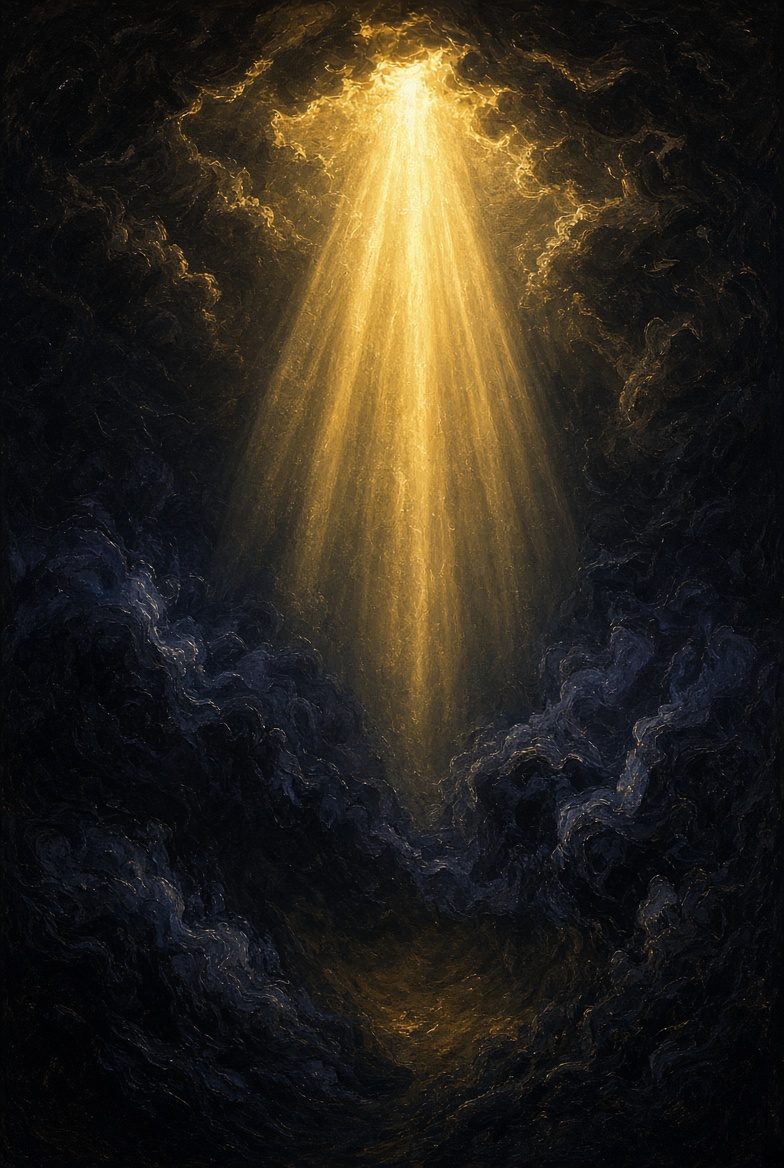
Those who read the Bible merely as a historical chronicle or a moral code miss its true power. It is the dramatic expression of humanity's struggle with chaos and order. It shows how, from the formless and the void—the tohu wa-bohu—light and structure emerge through the Word. This Word is the Logos. It is the principle that illuminates reality and simultaneously shapes the soul. The scriptures are hyper-interconnected, a living web of traditions that repeatedly leads humanity to the point of decision: submission to the higher power or sinking into its own arbitrariness.
God as an Abstracted Principle of Sovereignty
The idea of God is, first and foremost, the abstraction of sovereignty itself. In the natural world, we encounter the hierarchy of dominance. It begins with the individual who exercises power and extends to a principle that transcends the concrete bearer. God as Father is not the individual ruler, but the inner and outer law of order that provides support for the soul and the community. Whoever confuses this principle with the concrete sovereign falls prey to idolatry. Whoever denies it entirely opens the gates to chaos.
This hierarchy is not arbitrary. It corresponds to what is inherent in creation and in the human conscience. The Father in Heaven is the symbol of that authority which judges and preserves, which demands and sustains. Turning to this symbolic Father is the true act of freedom. For only those who submit to the Higher Power become capable of truly leading their own lives. The healthy family with a father and mother reflects this principle: the father as the bearer of order, the mother as the bearer of living wisdom and the unconscious.
The Logos as the creative word and sword of the soul
In the beginning was the Word. This Word is not mere language. It is consciousness that constitutes reality. Without the illuminating light of the Logos, experience disintegrates into darkness. Humankind is created in the image of this Logos—as a conscious being that creates order through attention, naming, and responsible action. The denial of this divine spark inevitably leads to nihilism and mental illness. The soul becomes ill when it is torn from its connection with the higher power.
The Logos is also the sword. It slays lies, self-deception, and ideological substitute religions. At the same time, it awakens true life. In the dark phase of Nigredo, the black night of the soul, humanity encounters this sword. It cuts away what is dead and clears the path to individuation. The liberation of the soul does not occur through self-realization in the modern sense, but through submission to the divine Logos and through the integration of what lies hidden in the unconscious.
Chaos and Order – The Struggle for the Soul
The world begins in chaos. The formless and the void demand the creative act. The hero who encounters chaos does so through awareness, through the word, and through the willingness to bear responsibility. In ancient myths and biblical narratives, this pattern appears again and again: the confrontation with the disordered, the establishment of boundaries, and the creation of meaning.
Modern ideologies attempt to tame this chaos through artificial systems. But they merely replace the living Logos with dead constructs. The result
It is destruction. The soul needs a connection to transcendence to withstand the suffering and limitations of existence. The biblical stories are history in the deepest sense: they lead us through the Fall into history—into mortality, guilt, and suffering—and simultaneously promise the path of redemption and restoration.
Sophia and Healthy Femininity as Complements to the Logos
The masculine alone cannot sustain order. It requires Sophia, divine wisdom, which resides in the unconscious and in healthy intuition. The Black Madonna stands as a symbol for this path: the dark, earthy figure of healthy femininity, yet interwoven with gold and light. She carries the flaming sword and the chain of transience, and yet she is the mother of wisdom, who supports and complements the masculine.
Love, as the union of healthy masculinity and healthy femininity, is where the Logos becomes flesh. In the sacred order of man and woman, of father and mother, the soul finds its completeness. The destruction of this order leads to gender confusion and the sickness of community. The rediscovery of Sophia therefore means the rediscovery of that intuition which serves and simultaneously nourishes the Logos.
The Path of Individuation and Conversion to the Father
The liberation of the soul is the path of individuation. It leads through the encounter with one's own shadow, with the unconscious, and with that which speaks in dreams and myth. This path provides orientation in the sense that it recognizes the Church as the living body and the sacraments as aids of grace, and at the same time, it is Jungian in that it takes archetypal images seriously and places them in the service of truth.
Conversion to the symbolic Father in Heaven is the decisive act. It demands courage. It demands the willingness to surrender one's autonomy to the Higher in order to receive it back in a purified form. Those who walk this path not only find inner peace but also become capable of bringing order to the world and bearing witness to beauty and goodness.
Take up the sword and live
Let us therefore take up the sword of the Logos. Let us die to falsehood and be reborn in truth. Let us rediscover the healthy order of the family, the wisdom of Sophia, and the paternal authority of the divine principle. For only in this way will the soul be redeemed from the darkness of modernity and led into the light of truth, beauty, and goodness. The path is steep, yet it is passable. The Logos calls. Repentance is possible. The soul may live.