The Purification of the Soul – From Vulgar Drive to Virtuous Order
We are driven. Society has become vulgar – and we with it. What was once considered a weakness to be kept hidden is now displayed in public. Desire dominates our vision, superficiality our soul, and self-reflection our words. Viciousness is no longer the exception, but the everyday reality. Yet the path from viciousness to virtue is not a straight path of easy improvement. It is a learning process with many setbacks, with falls and rebounds. I prefer failure a thousand times over to self-righteous repression. Those who fail do not repress themselves. They strive for integration. Only in this way can the complete transformation of life begin – not as external reform, but as inner conversion.
This conversion, however, demands more than personal effort. It requires the restoration of an order that binds what is driven and gives space to goodness.
The Necessity of Morality and the Paternal Order
This transformation succeeds only where morality prevails. First in the family, then in one's profession, in rental agreements, in every aspect of daily life. Morality is not moralism. It is the living orientation toward the good, the true, and the beautiful. When the father and husband is not the leader and neglects his duty, it becomes dangerous. Then Sleeping Beauty falls into the deep sleep of the unconscious. The soul of the family, the community, indeed, the culture, sinks. The responsibility lies with men. They must encourage Gretel to push the witch into the oven. Anyone who, as a child, was always forced to walk knows that childhood instincts must be overcome. The healthy family with mother and father is the first place of purification. Without it, the soul disintegrates into fragmentation and impulsiveness.
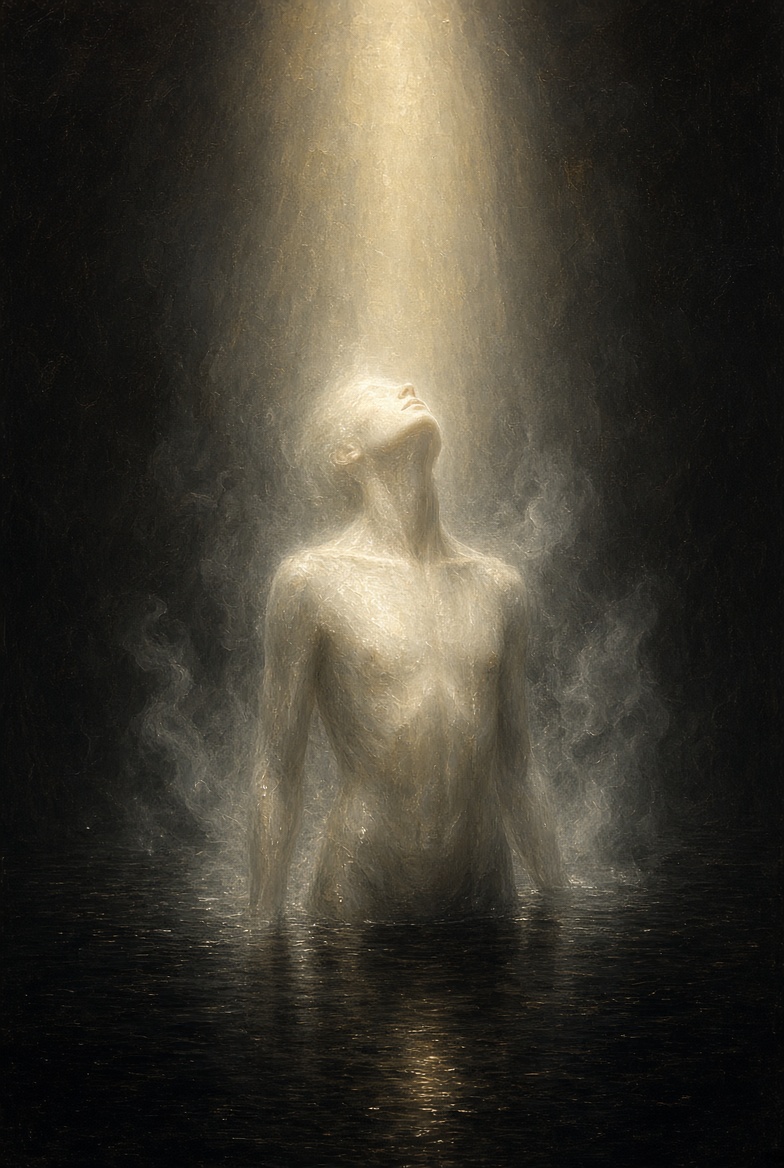
But this external order remains lifeless if it is not sustained from within. Therefore, the path necessarily leads to the question of purification itself. What purification truly means: Purification—in the character-based and religious sense—is the profound process of inner cleansing, moral improvement, and spiritual maturation. Character purification usually arises from crisis, a serious mistake, or a painful blow of fate. A person recognizes their errors, abandons bad habits, and gains maturity, humility, and compassion. In religious and Christian tradition, it is the soul's path to freeing itself from sin, guilt, and worldly attachments in order to draw closer to the divine: through repentance, penance, and forgiveness. Purgatory is the image of this purification. Water in baptism symbolizes both outer and inner purification. But purification always also means overcoming the hypersexualization that has gripped the West. It is not repression, but integration and transformation.
It is precisely here, however, that modern people are in danger of missing the true path and clinging to false images.
The Westerner and his distorted Buddhism
Westerners often misunderstand Eastern wisdom as "no attachment." In truth, it is letting go of images—the cloud of unknowing of the mystics. To do this, one must first recognize the images. The Westerner fantasizes about exotic, wise Buddhists. He doesn't dare to follow the path of the mystics, for then his house of cards would collapse. He is Peter Pan in the Buddhist temple, fantasizing about enlightenment and believing himself to be the next Buddha or Bodhidharma. Yet they, too, were only human. An Easterner would never dare such a thing. If he were to dedicate himself to Brother Klaus and Meister Eckhart, he would realize how small he truly is.
There is no ego – that is the Westerner's great wishful thinking, which he projects onto his distorted Buddhism. The Peter Pan Buddhist wants to rid himself of his soul and cries out: Everything is illusion and relative. But Buddha discovered precisely the opposite: There is something absolute. The soul cannot be destroyed. It can be purified and led to the divine. The teaching about the depths of the soul shows: Individuation is the path to liberation, not dissolution.
Only one thing leads out of this false spirituality: the return to the Logos, which alone fills empty words with life.
The Logos and Empty Words
The good news is proclaimed through the Logos. One can read the Bible aloud—without the Logos, without enlightenment, they remain empty words. The Logos is the word of repentance that awakens the soul. It is the sword that simultaneously kills and gives life. It kills the old, the vulgar, the driven—and awakens the new, the ordered, the divine. Without this Logos, all piety remains dead. Sixty years of globalization, sixty years of ecumenism, sixty years of interreligious rhetoric—the zeitgeist of globalization is long gone, and many haven't yet realized it. Demographic decline and the end of globalization are driving us back to the local. Nothing can
There is no true interreligious dialogue, for religions cannot be mixed or supplemented. Every tradition demands total devotion, not syncretistic compromise.
This Logos, however, does not only work in the mind. It also orders the souls of the sexes and protects them from confusion.
Anima, Animus, and the Order of the Sexes
For the animus not to overwhelm a woman, the masculine aspect of a man must be stronger and more dominant than the masculine aspect of a woman. Dominance in women is governed by the body—by pleasure or pain. Where this order is lacking, confusion arises, and women succumb to the animus. Love, however, is the union and completeness of healthy femininity and healthy masculinity. It is not about leveling, but about complementarity in the Logos. The soul finds its freedom only in this order.
In this order, the feminine appears not as an adversary, but as the bearer of a deeper mystery—visible in the symbol of the Black Madonna.
The Black Madonna and the Path of Sophia
The symbol of the Black Madonna points the way to healthy femininity. She is Sophia, the woman of God, the dark and wise side that leads to light through purification. In her, the soul encounters the mystery of transformation: that which lay in shadow becomes the bearer of grace. The Black Madonna is not sentimentality, but a call to the depths. She demands conversion to the symbolic Father—God in heaven—and the integration of the unconscious.
Whoever hears this call can no longer accept infantile excuses.
The Infantile Excuse and True Conversion
The reasons why people no longer go to church—"church is like French in school: everyone had to, but nobody liked it"—are extremely infantile excuses. They only show that one is still infantile. The church is not a place of comfort, but a place of conversion. Whoever seeks the Logos will not find it in the consumption of spirituality, but in obedience to the truth.
Conversion to the symbolic Father is the sword of the Logos. The liberation of the soul is the path of individuation. Only within the moral order of a healthy family and through mystical purification can humanity find its way back to truth, beauty, and goodness. Courageously and hopefully, we turn to the Logos. The complete renewal begins now—in character, in family, in soul.