The Sacrifice and the Sword of the Logos: Cain and Abel as a Mirror of the Soul
Dear brothers and sisters, in the profound silence of the biblical primeval history, the word of the hostile brothers resounds—a word that not merely recounts the past but calls the soul to repentance. It reveals the two primal paths of humanity after the Fall: the sincere sacrifice, which honors the Logos and opens the future, and the refused sacrifice, which sinks into resentment and murder. This reflection summarizes in detail the psychological and spiritual significance of this narrative: It shows how the right sacrifice liberates the soul, restores the healthy order of father and mother, and opens the path of individuation—toward the symbolic Father in Heaven.
The Sacrifice as the Primal Act of the Soul
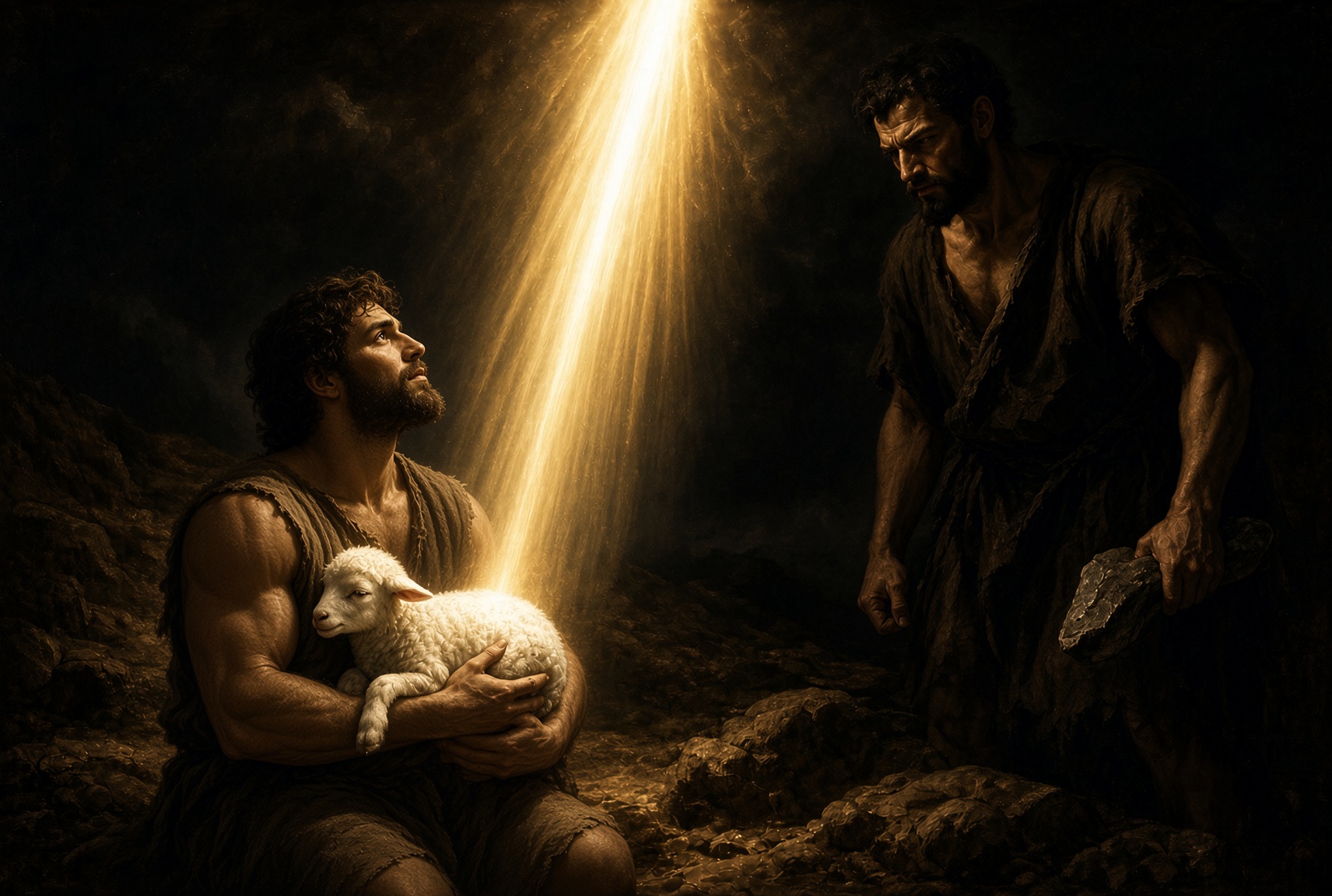
After the loss of Paradise and the recognition of good and evil, the first truly born emerge. Cain and Abel are no longer created beings but human beings exposed to the suffering of self-awareness. Here begins the true story of humanity. Abel offers the firstfruits of his flock—the best, the fattest, the most valuable. Cain offers from the fruits of the ground, but his offering is not accepted. Scripture leaves the reason in a sacred ambivalence: it is not enough to give just anything. It must be the whole, the best, the surrender of the present for the sake of a higher future.
Sacrifice here is not a magical rite of the past, but the primal act of reason and faith. It is the renunciation of immediate gratification so that the future may flourish. It is discipline, responsibility, and the conscious acceptance of limitation. Whoever sacrifices recognizes the order of the Logos: that life is not subject to the chaos of desire, but to the measure of the good. Sacrifice is the answer to the vulnerability that has come with self-awareness. It transforms fear into order and suffering into meaning. Without this sacrifice, humanity remains trapped in the present, and the future becomes a threat.
The Two Paths: Abel and Cain
Abel takes the path of the right sacrifice. His sacrifice is accepted, and he lives in the favor of the One who orders the world. He embodies the attitude of giving one's best and trusting in the divine. Cain, on the other hand, holds back. His sacrifice is incomplete. The rejection strikes him like a judgment, and his countenance darkens. Anger and despondency take hold. Here begins the nigredo of the soul—the darkness in which the unconscious still veils the truth but already urges a decision.
The two brothers are archetypal forces in every soul. One strives upward, toward goodness and order; the other sinks into shadow. Abel is the ideal that shines. Cain is the part that cannot bear the ideal because it shames him. They are the antagonistic brothers within: one who follows Logos, and the other who nurtures resentment. Both live within us. The choice of which we follow determines the path of the soul.
Resentment and the Invitation of Sin
God speaks to Cain: “Why are you angry, and why is your face downcast? If you do righteous things, you will be honored. But if you do not do righteous things, sin is crouching at the door; it desires you, yet you can rule over it.” This word is the word of repentance. It kills the illusion of innocence and simultaneously awakens it. It points to one's own responsibility. Sin is not an alien fate, but a power that one invites and nurtures. It lurks like a hungry animal, and Cain opens the door.
Cain chooses the opposite of repentance. He lets resentment grow, like a vulture over an egg. He broods over his failure, feeds fantasies of revenge, and kills his brother—and thus his own ideal. The murder is the consequence of refusing self-examination. Whoever destroys what is better because it shames them loses the path to the Logos. Resentment is the antithesis of gratitude. It transforms suffering into an accusation against God, against the world, and against one's neighbor. But Scripture teaches: The suffering of existence is a given. The response to it is decisive. Either one sacrifices and fixes one's gaze on the symbolic Father—the Logos, who sustains the world—or one refuses and becomes an instrument of destruction.
The Descendants of Refusal
The descendants of Cain build cities and forge weapons. The refusal to sacrifice is propagated and becomes societal. What begins in the individual ends in collective catastrophe. The murder of one's brother becomes the origin of violence that continues through the generations. Herein lies the moral truth: Resentment that is not overcome not only breeds personal ruin but also destroys the order of the community. The civilization founded on the refused sacrifice harbors the seeds of destruction within itself.
But the story does not end in darkness. It calls for repentance. The liberation of the soul occurs through individuation: through the conscious integration of the shadow, through the daily sacrifice of the lesser for the sake of the greater, through the rediscovery of the healthy order of masculine and feminine.
The Healthy Order and Sophia
Healthy masculinity bears responsibility and sacrifices for the future. Healthy femininity—symbolized by Sophia, wisdom, and intuition—complements and sustains. In the Catholic tradition, this appears in the image of the Black Madonna: the dark, mature mother who embodies the unconscious and Sophia and does not fight the masculine, but rather perfects it. Love is the union and completeness of healthy femininity and healthy masculinity. This archetype is reflected in the family, where mother and father together make sacrifices for their children. There, the soul is awakened, there, resentment dies, there, love arises as a living order.
The Sword of the Logos and the Path of Repentance
The right sacrifice is the path back to the Father. It is courageous because it accepts the pain of the present. It is optimistic because it trusts in the Logos, who creates life from death. It is moral and rational because it acknowledges the truth of the human condition: that without surrender to the good, only chaos remains. The word of Cain and Abel is a sword. It kills excuses and awakens at the same time. It is the word of repentance that awakens the soul and leads it to life.
Brothers and sisters, choose sacrifice. Fix your gaze on the symbolic Father in Heaven. Let the soul be freed on the path of individuation. Then, from the darkness of Nigredo, the light of truth, beauty, and goodness will emerge. The Logos waits—and the sword that kills and awakens is ready.