When a Marriage Breaks Down – Divorce as an Involuntary Initiation Ritual for the Modern Man
Dear brothers and sisters, a contemplation on the collapse of the man after divorce has revealed the surface: the asymmetry of preparation, the collapse of the support network, the anger as a language of powerlessness. Beneath this lies the real message. For the modern man, divorce is not merely a private failure. It is an involuntary rite of passage. It reveals that - despite career, home, and children - he was still emotionally connected to his mother. The betrayal and breach of trust by his wife, wherever they occur, are catastrophic and existential. They destabilize past, memory, present, and future. Everything collapses. This is the death of an identity. At the same time, divorce, precisely because it is so destructive, is a religious transformation: The missing male bond in our society is enacted here without temples, without elders, without blessing—through collapse.
The Collapse of Time
Those who are betrayed or abandoned lose not only a person. They lose the legibility of their lives. The past is rewritten retrospectively: What was considered love? What was duty? What had long been a farewell, one that no one wanted to acknowledge? Every shared photograph, every celebration, every word spoken at the kitchen table falls under suspicion. Memory no longer holds. It becomes a judgment.
The present loses its structure. House, bed, table, walk to school, evening—the man's familiar surroundings as a father and husband—become foreign territory or a subject of negotiation. The future, which he had envisioned as a continuum, breaks down. Career, age, the second half of life: everything must be recalculated, and from a state in which the self no longer seems credible.
For betrayal doesn't just shatter trust in another person. It shatters trust in humanity - and above all, in oneself. Anyone who has followed a decision, a woman, a commitment so far must, after the break, ask themselves: Can I still trust my own judgments? Have I mistaken falsehood for truth for years? This self-shattering is deeper than the legal separation. It is the death of the former self.
For betrayal doesn't just shake trust in another person. It shakes trust in humanity - and above all, in oneself. Objectively speaking, this often includes the observed asymmetry. In many marriages that end, the wife has internally processed the breakup over years. The other experiences it like an earthquake. Studies show that women initiate the majority of divorces. Those who sense the rift early grieve beforehand, build a support network, construct a narrative. Those who mistake the present for the continuity sleep on the fault line. Revelation without preparation is trauma.
She began to leave two years ago. You found out last night.
That doesn't change the severity of the blow. It only explains why it hits so hard. And it obliges the man to acknowledge two things simultaneously: the actual damage—and his own blindness, which made the damage visible only so late.
Still with the Mother
Modern society has largely abolished the ritual initiation of men. There is school, sports, military service, career. There is rarely the orderly death of the boy in the presence of his fathers. There is rarely the eldest who says: You are now leaving your mother's tent. You are exposed to the dangers of your own soul. You return changed.
Where this ritual is absent, protection remains. The mother—physical or as an inner authority - protects her son from his own inner world. She dampens fear, shame, aggression, and longing. She keeps the chaos out. This is appropriate in childhood. In manhood, it becomes imprisonment. The adult man may be outwardly independent but inwardly unresolved: He continues to seek a space that holds him, comforts him, justifies him, and protects him from confronting his own shadow.
The Soul Image Migrates
Depth psychology has described what happens here. The unconscious image of woman - the anima, the inner feminine - is first formed in relation to the mother. Later, it migrates to the partner. The wife thus often takes on not only love, home, and motherhood. She assumes the psychological protective function of the mother. She becomes the guardian of the inner home. As long as she is there, the man does not have to live alone with the unconscious.
This is not an accusation against the woman. It is a diagnosis of the man. A healthy marriage can heal this transference by allowing both partners to mature: he detaches himself, she becomes a companion instead of a surrogate mother, both are guided by the Logos, not by the bond of childhood. An unresolved marriage, however, nurtures the delusion. The man calls bondage what is dependence. He calls love what is the avoidance of his own soul.
Therefore, the woman's departure is more devastating than a mere contractual loss. It is not only his partner who falls. It is the last representative of the mother who falls. The protective system collapses. The man is thrown out of his home - not just his apartment, but his psychological home. The thing that protected him from himself.
Divorce as an involuntary rite of passage for the modern man – Divorce as religious transformation
Ancient cultures knew the transition: removal from the mother's house, testing, symbolic death, rebirth among men, return with a new name. The modern man often only goes through this process when no one wants to guide him anymore – through divorce, in midlife, without a ritual master, often in front of his children and the court.
The analogy is accurate if one doesn't romanticize it. The classical rite was intentional, sustained, and limited. Divorce is involuntary, unsustainable, and often endless. Yet it accomplishes what society has denied: it kills the old identity. It exposes the man to the dangers of his own soul. It forces an encounter with the shadow. It makes the integration of the archetypal feminine (Black Madonna) within himself inevitable – or it causes him to harden, become bitter, and remain childlike.
Being Devoured
The images of initiation depict being devoured: by the monster, by the night, by maternal chaos. The candidate enters into that from which he must detach himself, and returns only transformed. Divorce has this effect. The home that nurtured and sustained becomes an abyss. Memory, guilt, desire, hatred, longing for return - everything rises up at once. This is the nigredo: blackening, decay, dark night. Nothing gleams. The stone must shatter.
Whoever denies this death remains in the antechamber. He quickly seeks the next woman as a new mother. He wages war over the narrative, to be right like a child before the authorities. He numbs himself. He works himself to death. All of these are escape routes from the actual ritual. The ritual demands something else: to remain standing in the collapse, to let the old form die, not to immediately build a replacement home.
What is religious about it?
Religious here does not mean sanctifying divorce or disregarding the bond. The bond between man and woman, mother and father, remains the measure and the goal. Religious means: The process concerns the soul's relationship to its ground. The man, deprived of the protective feminine, stands naked before the Father in Heaven - or before nothingness. There is no comfortable middle ground.
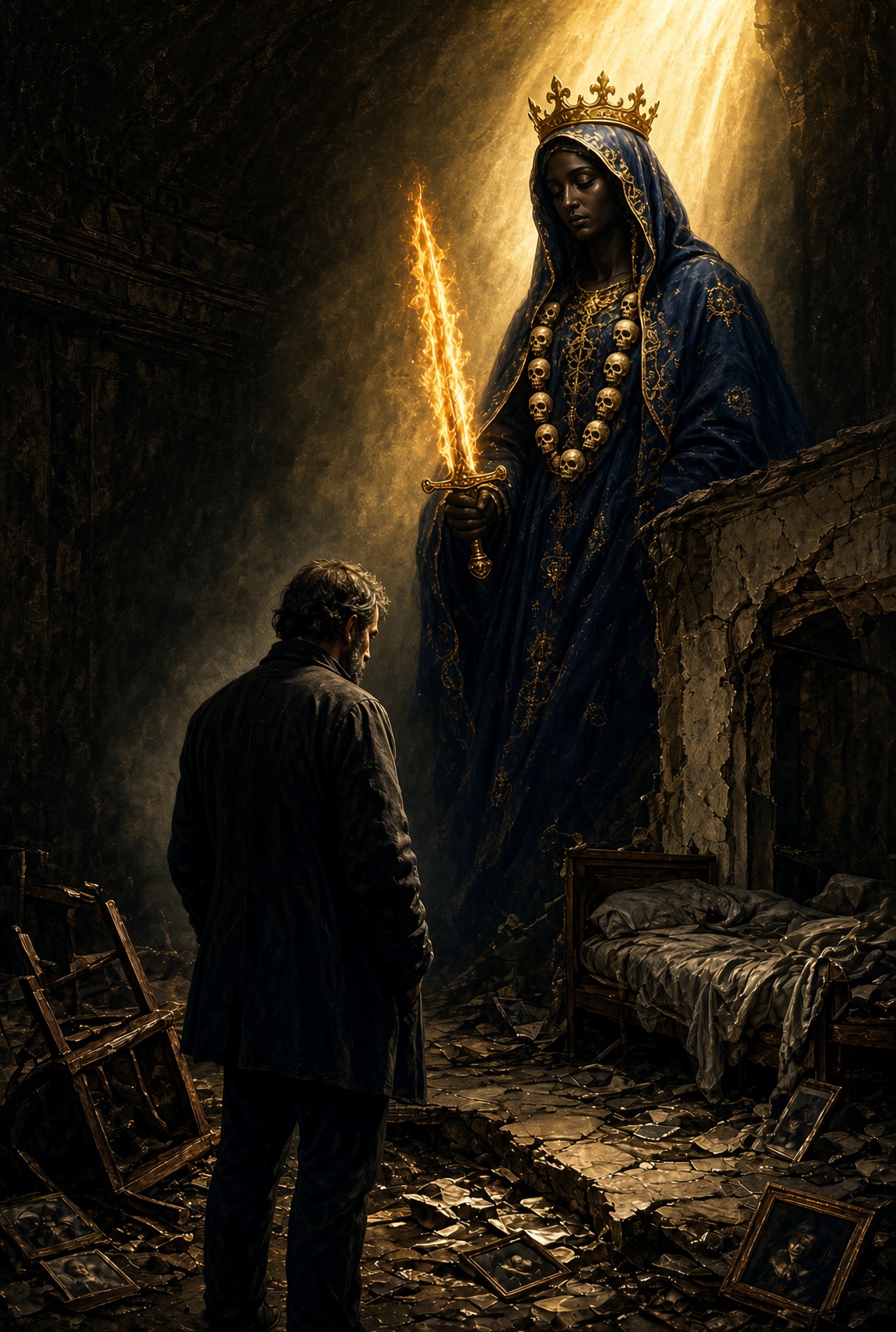
The word of reversal is the sword that kills and gives life. It kills identification with role, resentment, self-pity, and the hope of getting the old order back unchanged. It awakens the possibility of being a man without a representative. Without this word, Nigredo remains mere destruction. With it, it becomes passage.
The Shadow and the Inner Woman
As soon as the protection falls, what the mother and later the woman kept at bay appears. Fear without solace. Shame without justification. Anger without a permissible target. One's own coldness. One's own neediness. One's own contribution to decay: numbness, complacency, domination or escape, the prolonged failure to listen. This is the shadow. To ignore it is the true betrayal of oneself - deeper even than the betrayal one has suffered.
At the same time, the inner feminine rises, now without an external bearer. Unintegrated, it appears as bitterness toward all women, as an addiction to salvation, as contempt, or as an ideal that no living companion can ever fulfill. Integrated, it appears as Sophia: intuition, discernment, the ability to sense the rift early and name it instead of denying it. The Black Madonna is not man's adversary here. She is the image of wisdom in darkness - the unconscious that serves Logos instead of replacing it.
A complete man is not one who has expelled the feminine. It is one who no longer delegates it to mother or wife. He embodies discernment and receptivity in one person. Then a woman can be a companion, not a substitute for home. Then a father can give his children boundaries and warmth without making the mother an enemy or a throne.
Anger is not yet Initiation
Fear, grief, and shame quickly turn into anger for many men. Anger simulates strength where there is powerlessness. It is understandable because it is injustice. It is rarely the goal. Whoever, in a state of being overwhelmed, threatens, writes, seeks public battles over history, feeds the very narrative that already devalues him. This is not a moral extra. It is a law of crisis: dysregulation confirms the accusation.
Initiation requires moderation. A night's distance before the momentous word. Do not make the child a messenger, witness, or judge. Seek support—fraternal, spiritual, and, where necessary, medical - before negotiating. Whoever negotiates as a wounded man pays the price of the wound. The ritual is not war against the woman. The ritual is standing before one's own foundation.
The Network, the Father, the Child
Many men have delegated friendship to marriage. If the wife falls, the network falls: the loyalty.
Those who are willing to go with her, the cowards withdraw, the secretive ones only greet her privately, and relatives often stay because of the children. Social homelessness arises. This, too, is part of initiation. The boy lived in his mother's house. The man needs brothers. Whoever discovers after separation that he has none discovers an incomplete separation.
Brotherhood does not arise from circles of lamentation, nor from a common enemy. It arises from work, reliability, prayer, from the willingness to support the other without exploiting them. A life after divorce that clings only to the gaze of the former partner is not freedom. It is the old maternal bond under a new name.
The child needs the father. That remains non-negotiable. Even after the break. The father who wins the war and loses the child has failed the ritual. The father who remains - in moderation, in proximity, without turning the child into a weapon - accomplishes the more difficult part: He dies as a husband in the old way and lives on as a father. This is not sentimentality. This is order.
What the ritual demands
- First: Acknowledge the death of the old identity. Do not gloss over it. Do not immediately replace it. The memory may hurt. It must not become a constant indictment of reality.
- Second: Name the betrayal suffered, without denying one's own blindness. Both are part of the truth. Those who are only victims remain children. Those who only take on guilt to avoid pain also remain children.
- Third: Enter the shadow. What the woman held must now be borne within. Without this work, the man seeks the next guardian and repeats the bond as a childhood contract.
- Fourth: Integrate the inner feminine. Sophia serves the Logos. She is discernment, not escape; intuition, not secrecy. Sick femininity departs without a word and calls it freedom. Sick masculinity explodes without measure and calls it truth. The ritual bypasses both.
- Fifth: Return to the symbolic father. Not to the party of men, not to revenge, not to ideology. To the measure that stands above mother and wife. The Logos is the word that awakens the soul. Without it, initiation ends in cynicism.
- Sixth: To build a life that sustains, even when no one plays the mother role anymore. Work, prayer, brotherhood, fatherhood, reason. To bear experience without making it the definition of the future. That is individuation: not forgetting, but transformation.
The Reversal Word
The dark night is not the final word. It is the furnace. What must burn in it is often not love itself, but the false image of it: possessions, comfort, the refusal to grow up, the hope of dwelling eternally in the wife's home without being a home oneself.
- To the brothers: The fall does not prove that you are worthless. It proves that an unresolved bond has come to an end. If the house falls, do not fall with it. Stand. Mourn as men. Do not become hard on the feminine, nor soft on the lie. Return to the Father. Only then can you be companions again - or stand alone with dignity.
- To the sisters: Sensing the rift early is a gift, if it leads to the timely word that unites. It is hurt and betrayal if it leads to a silent departure while the other is still asleep in the shared home. Sophia serves life, not secret execution. The word, spoken truthfully and early, is more merciful than the prepared narrative at the end.
- To both of you: The marriage of mother and father remains the standard. Where it breaks, responsibility remains. Love is not the survival of a form at any cost. Love is the union of healthy femininity and healthy masculinity under the Logos. The modern man is often truly weaned for the first time in divorce. This is cruel. It can be, if he does not resist, the beginning of true manhood.
The Mistake of Fact by Mother and Wife
In conclusion, it must be said that the man did not want the wrong thing. He misjudged what lay before him. Because he was not initiated into religion and sexuality, he inwardly confused his own mother with his wife. Each intermediate step was correct in itself: seeking protection, trusting a woman, finding peace in home. Only the assumption that the wife was the mother was wrong. That is why the end is the opposite of what was sought: instead of home, homelessness; instead of protection, exposure; instead of trust, a break with oneself.
The mistake remains invisible for a long time because it works. Only when the bearer of it disappears does it become clear: what held him back was not the wife, but the unresolved image of the mother she held. Those who fail to grasp this call the path stupidity or malice. It is neither.
The sword has been drawn. It can wound, or it can cut the knot that binds the soul to the mother, to resentment, and to the dead. Choose the latter. Master Reding