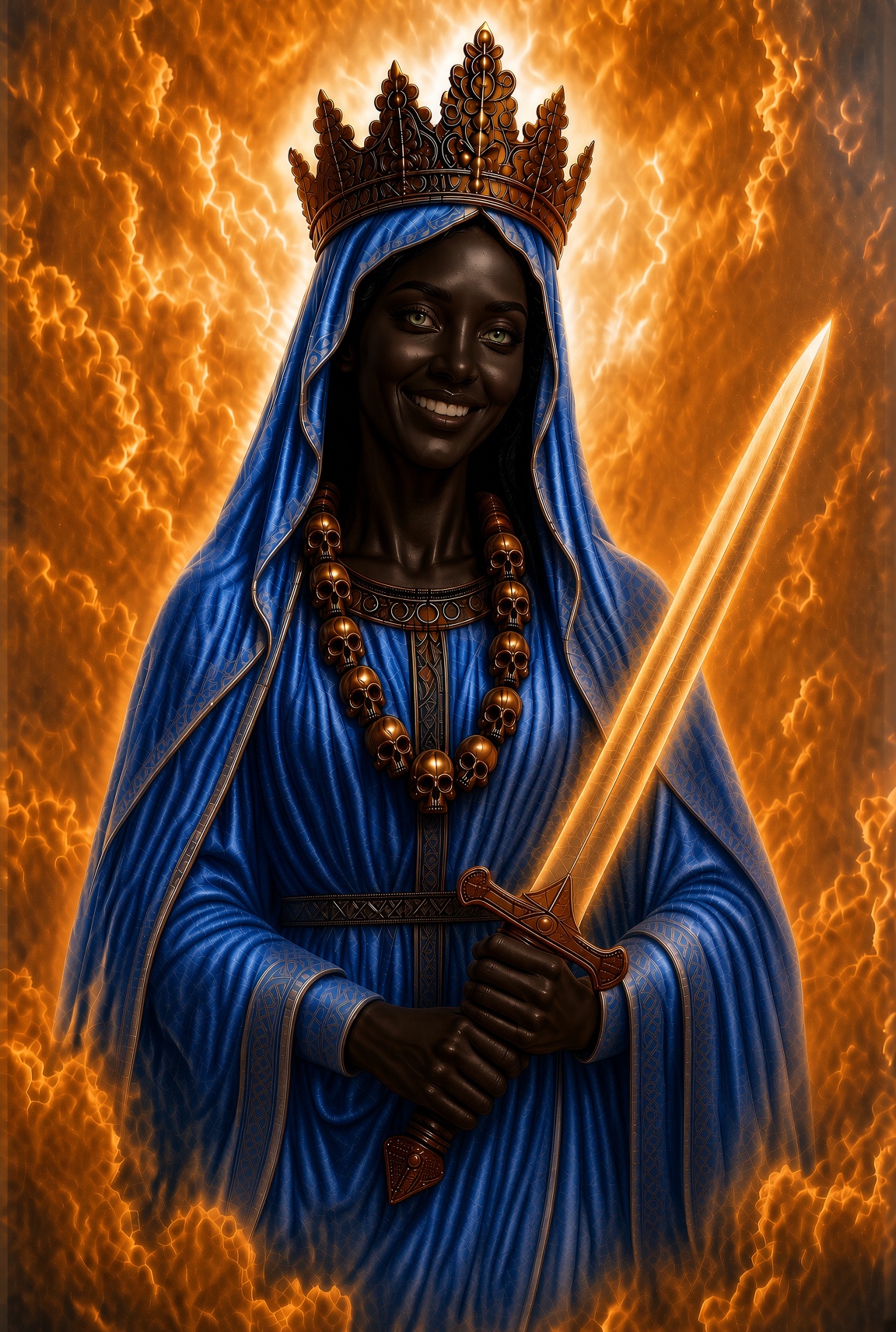
Dogma as an Axiom of the Soul – The Black Madonna and the Path of Neither Idealizing nor Demonizing the Feminine
Dear brothers and sisters, in the silence of the inner monastery, where the soul matures in the Nigredo of self-examination, we recognize: Dogma is not a dead law, but a living axiom of the human soul. Just as mathematics does not invent its fundamental truths, but continually discovers and preserves them, so too does Christian dogma carry within it the unchanging cornerstones of the soul. Axioms must not contradict one another – yet they may grow and open up new dimensions. So that we neither idealize nor demonize the feminine, that is the Black Madonna, venerated for hundreds of years, must be understood axiomatically. She is not a new construct, but an ancient, living axiom of the soul. In her, the Christian journey of the soul finds its necessary expansion: the unity of heaven and earth, of spirit and matter, of healthy masculinity and healthy femininity – and the return to the Divine Logos.
Dogma as an Unshakable Axiom of the Soul - The Black Madonna
The human soul is not an empty vessel. It contains fundamental structures that correspond to both revelation and reason. Dogma—the Church's clear doctrine of the Trinity, the Incarnation, and Mary as the Mother of God—is an axiom in the strictest sense: an unshakable truth that does not contradict itself and upon which everything else can rest. Whoever denies these axioms builds on sand. Yet tradition is not rigid. It is alive because the Holy Spirit stirs within it, continually leading the soul to deeper understanding. Fidelity to dogma does not mean stagnation, but rather the readiness to discover, in faithfulness, new dimensions of the same mystery that are compatible with the old.
The Age of Dissolution and the Loss of the Center
The age in which we live is an age of dissolution. Church, culture, and religion have lost their center. The power of faith has become a weak feeling, discipline a game of opinions. Where once seriousness, dignity, and responsibility prevailed, today arbitrariness and self-absorption reign. Humanity seeks to understand without receiving – to act without listening – to create without serving. This division is the root of the problem: humanity has lost the unity of spirit and form, of heaven and earth. The Nigredo Monastery stands in opposition to this – not as an escape from the world, but as a conscious return to order, spirit, embodiment, and wholeness.
The twofold danger: Idealization and demonization of the feminine
The classical depiction of Mary as the immaculate Queen of Heaven is true and holy. But when holiness is emphasized to such an extent that every trace of earth, of night, and of dark wisdom disappears, then we are idealizing. The overly holy Mary becomes unattainable. The real woman no longer finds a reflection in her. The receptive, nurturing, and formative aspects are suppressed.
The opposite is demonization. For centuries, the Church, too, has often viewed the feminine with suspicion – as temptation rather than revelation. Matter was declared a danger instead of being recognized as the vessel of the spirit. Today, the pendulum swings in the other direction: femininity becomes an ideology or a function. Mothers are no longer allowed to be mothers. Both idealization and demonization divide the soul. Both prevent healthy femininity and healthy masculinity.
The Black Madonna as an Axiomatic Center
In order to avoid both idealizing and demonizing the feminine, that is, Mary, the Black Madonna must be understood axiomatically. She has been venerated for hundreds of years—in ancient pilgrimage sites, in monasteries, in the quiet piety of the people. She is not a modern construct or a romantic invention. She is a living axiom of the Christian soul.
In the dark, earthy, often silent figures, Mary appears not only as the pure Queen of Heaven, but as the one who knows the night of the soul. She is Sophia, divine wisdom, who dwells in darkness and yet gives birth to light. According to Jung's depth psychology, this image is an archetype of mature, integrated femininity: not destructive darkness, but the fertile night in which the unconscious is purified. The blackness is not a lack of holiness, but its deepening. It shows that true holiness does not leave the earth, but permeates it. The Black Madonna maintains the tension: holy and earthbound, pure and wise, receptive and subject to the Logos. She heals one-sidedness without destroying dogma. She completes it.
The Flight of the Masculine and the Necessity of Integration
As the depth psychologist von Franz describes, the masculine principle flees when it encounters the wise
Unacknowledged within, man often seeks security in his intellect and in unconscious substitute actions. He seeks security in thought and intellectual constructs to escape confrontation with body, soul, and woman. This escape is not true spiritualization, but rather defense mechanism. To integrate the feminine within means: to feel without losing oneself; to receive without fleeing; to love without possessing. This is the true maturity of man—and it becomes possible through the axiomatic understanding of the Black Madonna.
Parzival, Kundry, and the Path Through the Nigredo
Parzival is the archetype of the unfinished man. He seeks the Grail, but he fails because he does not ask questions. He wants to conquer and know, but remains blind to suffering and mystery. In this story, it is Kundry who embodies the unresolved feminine. She appears as a wild, dark, probing figure—messenger of the Grail and at the same time bearer of ambivalence, shame, and unredeemed depths. Kundry is neither a pure saint nor a pure demon. She is the challenge that Parzival must face to mature.
Only when he passes through error, shame, and silence, and withstands his encounter with Kundry, does the transformation begin. He recognizes that knowledge without compassion remains empty and that the feminine must not be repressed, idealized, or demonized. Thus, he becomes a true knight not through external battle, but through insight and acceptance. Parzival represents the modern man: courageous, searching, yet cut off from the inner feminine. He must pass through the darkness—through the Nigredo—to find the heart. Kundry is the figure who compels him to see the dark side of the soul. For only those who honor the soul can comprehend the spirit.
The Black Madonna and Kundry touch each other at this profound level: both embody the feminine, which must be neither glorified nor condemned, but rather axiomatically accepted and redeemed.
The Martial Path of Nigredo Monastery
Nigredo Monastery is martial in the truest sense: orderly, disciplined, and vigilant. It is for men who sense that something within them remains unfinished. Work, prayer, silence, and chastity are the pillars of restoration. Chastity is the mastery of one's own energy—directed toward work, God, service, and protection. Sexuality has its place again: in the marital bed of a healthy marriage between mother and father. The man who understands the Black Madonna axiomatically and withstands the encounter with the Kundry-like within himself becomes neither soft nor hard. He becomes a bearer of order, so that the feminine can blossom in safety.
Back to the Father through the Honest Acceptance of the Feminine
The path back to the Father does not lead through contempt for the feminine, but through its genuine acceptance. Only those who honor the mother—neither idealizing nor demonizing her—can recognize the father. The father represents order, spirit, and direction. The mother represents form and life. The man who unites both within himself carries heaven within him. The Black Madonna is the axiomatic symbol of this unity. She preserves the sanctity of Mary and simultaneously restores to the feminine its full, earthbound dignity.
The Responsibility of Man and the Rebirth of Order
In the Nigredo Monastery, responsibility clearly lies with the man—not as domination, but as service. He upholds order so that the feminine can flourish protected. If the man fails, the family disintegrates. If the family disintegrates, culture dies. Therefore, renewal begins with him: in silence, in work, in prayer. The martial spirit calls men back to piety, chastity, and responsibility. For the world needs men who can stand firm again—firm in the material world, rooted in the soul, directed toward the spirit and toward divine agape.
Only in this way can the sacred be re-embodied. Only in this way can the new balance between feminine and masculine arise—the rebirth of living faith from the darkness of Nigredo into the light. Thus, dogma becomes what it always was: an axiom of the soul. The Black Madonna, venerated for hundreds of years, stands at its heart as a living axiom. She protects us from idealizing or demonizing Mary and the feminine. She leads the soul to truth, beauty, and goodness. She calls for a return to the symbolic Father and the liberation of the soul through individuation. And she bestows upon us the image of a femininity that heals and a love that reunites man and woman in their healthy, complete form.
May this axiom grow within us. May the soul, in the silence of the monastery, recognize the Black Madonna and, through her, find the path to the living Logos. For only in this way will Christianity not be narrowed but broadened—and the soul not bound but set free.