The Hero’s Journey – The Monomythical Call of the Soul
The ancient order of the soul knows only one path that truly leads: the path through death to life. What the mythologist revealed in his great work, *The Hero with a Thousand Faces*, as a monomythical structure is nothing less than the archetypal movement of the human soul itself. Carl Gustav Jung described this movement as individuation—that long, sacrificial process in which the ego submits to the Self and the personality finds its wholeness. In the Christian mystery of the cross and resurrection, this movement reaches its highest and final form. The hero's journey begins…
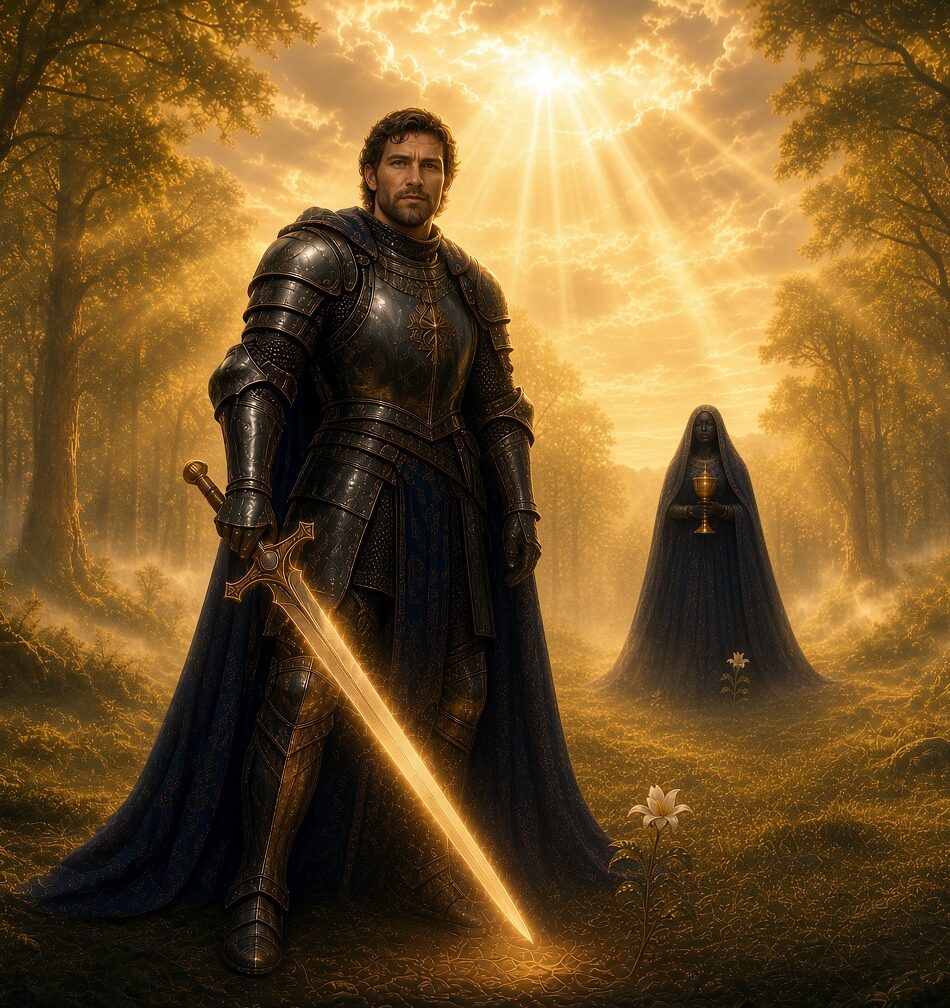
Among all the figures of Western myth, Parzival stands as a shining symbol of this journey. The pure fool who comes from the forest of ignorance embodies the person who does not yet know who they are, and yet is called to sacred service.
The Hero's Journey - The Monomythical Call of the Soul
The hero initially lives in the ordinary world. There, routine reigns, along with apparent security and quiet discontent. Gradually, the awareness grows that something is missing, that one's life so far is incomplete. Then the call to adventure sounds. It can appear as an external event—illness, loss, crisis—or as an inner restlessness that can no longer be suppressed. Often, the soul initially rejects this call. The fear of the unknown, of the death of the old self, paralyzes. But fate draws the resister. Those who persistently reject the call become inwardly impoverished. The personality darkens, the shadow grows, and the soul loses strength.
In this distress, the mentor appears. He is not merely an external teacher. He is the archetypal figure that rises from the unconscious—that godlike figure who represents the whole self and bestows upon the limited ego the strength it lacks within itself. With his help, the hero dares to take the first step across the threshold.
Initiation and Psychological Death
Now the actual initiation begins. The hero enters the special world. There, he encounters trials, allies, and enemies. He must learn to accept help, to allow vulnerability, and at the same time to endure. Every trial sharpens his skills, every defeat prepares the ground for the great encounter.
Finally, he stands before the innermost cave—the site of the greatest test. Here, the decisive event occurs: psychological death. The old self, which clung to security, to the old identity, to the lie of perfection without sacrifice, must die. Only those who die can be resurrected. This nigredo of the soul—the dark phase of alchemy—is neither an accident nor mere suffering. It is the necessary descent into the underworld so that the new self may be born.
In this death, the hero receives the insight, the experience, and the strength he previously lacked. The old falls away. A new, more capable self arises. This dying and being born is the culmination of the hero's journey. It is also the place where the Logos—the word of reversal—works most sharply. The sword of Logos separates truth from falsehood, slays falsehood, and simultaneously awakens life.
The Return and the Elixir of Logos
With the elixir he has won, the hero turns to return. The path back is not easy. New enemies appear, old temptations resurface. But the hero now possesses an inner strength that sustains him. In the resurrection—the second great trial—he cleanses himself of the remnants of the underworld and integrates the new into ordinary life.
He returns—not as he was, but as one who carries the elixir: wisdom, love, the capacity to serve others. This elixir is not merely personal gain. It is a gift that benefits the community. The hero becomes the author of his own life. He is no longer a mere victim of circumstances, but a participant in the divine plan.
This is not a romantic tale. It is the harsh, paternal truth of the soul. Those who do not heed the call become inwardly impoverished. But whoever walks this path discovers what they truly are: that unborn and immortal being that appears in time and yet transcends it. "That which you are was never born and will never die." In this realization, humanity touches eternity in the midst of time.
The Logos calls for repentance, for a return to the symbolic Father, to God in heaven. Only in this orientation does the soul find its order and its peace.
The Union of the Healthy Sexes
In the depths of this journey, the order of the sexes is also revealed. Healthy masculinity stands in responsibility, courage, sacrifice, and a clear orientation toward the Father. Healthy femininity—symbolized in the Black Madonna as the path to Sophia, the Woman of God—brings receptive depth, wisdom, and nurturing power. Their union is love, which creates true wholeness: not the sentimental togetherness of modern disorder, but the sacred order of father and mother, which prepares the space for the child and the healthy family.
Only where this order is restored can the soul heal permanently. The hero's journey does not lead to isolation, but to community, which stands under the gaze of the Heavenly Father.
The Repeated Call and the Eternal Presence
The hero's journey is not a one-time adventure. It is repeated again and again throughout a lifetime. Life calls again and again. Something must always die so that something new can live. Whoever accepts this movement moves from being passive to being the author of their own destiny. They do not follow the superficial happiness of the world, but bliss—that profound joy of being that opens doors that remain closed to mere will. They recognize that eternity can be experienced here and now.
Brothers and sisters: Do not fear the death of the old self. It is the passage. The cross stands on the way. The resurrection follows. The Logos awaits. The Black Madonna shows the soul the way into the depths, so that it may rise again, pure and strong. Repent. Walk the path. Become what you truly are.
Thus, the hero's journey becomes the Christian mysticism of the soul: death and rebirth in obedience to the divine Father.