Without Religion, One Cannot Break Free from the Mother – Divorce as an Involuntary Initiation Ritual
Dear brothers and sisters, in a culture that has abandoned sacred male initiations, divorce becomes for many men a dark, involuntary passage through the Nigredo. What once served as a conscious initiation of the soul—separation from the maternal bond, confrontation with one's own shadow, and rebirth in mature masculinity—must today often be endured in the pain of betrayal, custody battles, and the sight of the truly evil face. This text describes why divorce must be understood as a religious and psychological initiation, and how the man who chooses the Logos, through the pangs of this spiritual birth, arrives at authentic fatherhood and union with the Heavenly Father. But that is religion: it cannot exist without the other. Without religion, one cannot break free from the mother.
A Glimpse into the Face of True Evil
Our culture no longer knows voluntary initiation rituals that liberate boys from maternal protection and introduce them to the world of men. Therefore, many men must undergo this transformation involuntarily—in divorce.
When a man and his children narrowly escape the "silver bullet" method in divorce and custody proceedings, he looks into the face of true evil. It is a shock that cuts deep into the heart because he has gazed into the abyss of the satanic face within another human being. Betrayal, emotional pain, and the horror that such a thing is possible shatter his entire identity. Giuseppe Motta is right: Misfortune is the measure of greatness of character. This glimpse is the beginning of initiation.
The Lost Initiation of Tradition
Traditional societies initiated boys into manhood through structured, agonizing trials. They separated him from maternal influence, confronted him with his limitations, taught him the wisdom of the fathers, and gave him recognition within the male community. All of this was lacking in the modern world. The result is generations of chronologically adult men with adolescent psychology: without firm boundaries, without self-discipline, constantly seeking validation, idealizing or demonizing the feminine, insecure in their masculine identity. Some compensate with hypermasculinity, others withdraw into passivity. Both paths remain regression or compensation—not true initiation.
The Burden of an Unlived Life
The greatest burden a child must bear is the unlived life of their parents. Uninitiated fathers cannot initiate their sons. Thus, a cycle of psychologically incomplete men is created. The growing young man must be able to free himself from the anima's fascination with his mother. Mere adulthood and external separation are not enough. The profound initiation of men and the rebirth ceremony are necessary to effectively complete the separation from the mother and thus from childhood.
The Mother Image in Marriage
In a marriage entered into without this initiation, the man unconsciously transfers the mother image to the woman. He becomes childish, sentimental, dependent, and subservient—or, conversely, tyrannical and preoccupied with his own prestige. Under the guise of the ideal marriage, he seeks the magical protection of the mother in his wife. His fear of the dark unpredictability of the unconscious grants the woman an illegitimate power. The marriage threatens to shatter due to inner tension. This is precisely where divorce must be understood: as a religious matter. Only in this way can it be experienced and endured.
The Journey Through the Shadow After Midlife
After midlife, a persistent loss of anima leads to stagnation, fanaticism, or childish effeminacy. Man must therefore—voluntarily or involuntarily—embark on the journey into the depths of his own shadow, integrate the opposing forces, and discover the self. In the Christian tradition, Christ is the living symbol of this self. The protection that the mother once offered against the dangers of the soul is replaced by instruction about matters beyond—by religion. Only men can educate men. In a society without initiation rites, men remain dependent on the mother and are consumed by the symbolic death mother.
King, Queen, and the Order of the Soul
Marie-Louise von Franz described the sociological condition: Where the king is spiritually blind and absent, the queen inevitably becomes a witch, devouring her own children and grandchildren and needing eunuchs at her side. When men are no longer men, women can no longer be women. The father's blessing strengthens the houses of his children; the mother's curse uproots their foundations.
The Birth Pains of the Self
The painful time of divorce is the birth pains of the self. The self is born, and every birth is painful. It is a spiritual and religious birth with all its natural labor pains and phases, just like a physical birth. The man must try to surrender himself completely to the Spirit. He surrenders to the Spirit and yet has a justified fear of dying in the process. Therefore, trust is necessary.
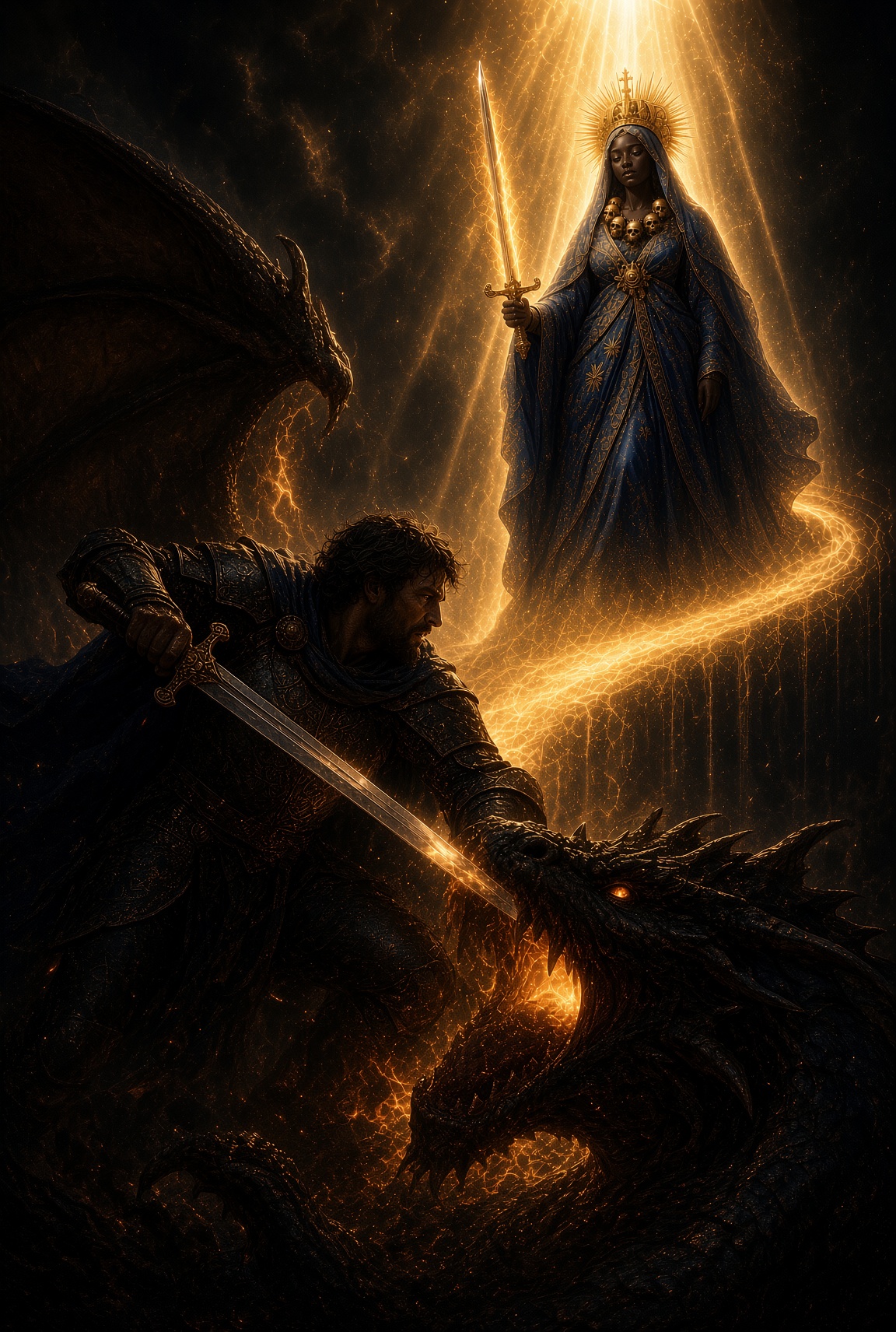
Just as the woman also has a justified fear of dying during physical childbirth, and yet must fully surrender to the will of the body, so too must the man, in the pains of divorce, trust in the work of the Holy Spirit. The unconscious and healthy intuition—as expressions of Sophia—support and complement the masculine here. The Black Madonna, symbol of Sophia, points the way to this healthy femininity, which does not devour the man but carries him through the fear of death.
Without religion, one cannot separate from the mother - Divorce as an involuntary initiation ritual
But the man cannot accomplish this spiritual birth alone. He must then be initiated into religion and into a proper, orderly sexuality. Otherwise, he remains stuck in labor and dies, either physically or spiritually.
Without religion, into which he is initiated by older, mature men, he cannot separate himself from the mother. For the mother protects him from inner evil. As long as he does not assume this inner protective function through religion itself, he remains bound to her. Religion gives him the strength and order to protect himself against the powers of darkness. Without this initiation, he repeatedly chooses the death mother as his partner. And each time, the choice becomes a step more sick and toxic, until in the end he is killed by her—physically or spiritually.
This process is religion. Without religion, one cannot separate oneself from the mother. Only the religion received from the fathers breaks this deadly cycle and completes the birth of the self.
The Return to the Heavenly Father and the Black Madonna
But the initiation does not end in turning black. The man who has weathered the abyss and the pangs of childbirth, and who has been initiated into religion and proper sexuality by older men, learns the delicate balance: to honor the feminine (Black Madonna) without being consumed by it, and at the same time to establish masculine autonomy. Love thus becomes once again the union and completeness of healthy masculinity and healthy femininity.
The uninitiated man must seek his own initiation: mentors among mature men, voluntary testing of his own limits, the study of masculine wisdom traditions, and above all, turning back to the symbolic Father—God in Heaven. The Logos is the word of conversion that awakens the soul, simultaneously killing and calling it to life. The liberation of the soul is the path of individuation.
Thus, involuntary divorce, which arrives like a silver bullet, becomes a potential gateway. Those who can bear the gaze into the face of evil, trust in the birth pangs of self-discovery, allow themselves to be initiated into religion by older men, and turn to the heavenly Father, emerge from maternal dependence and become capable of being fathers themselves—in a healthy family where mother and father have their rightful place. This is the hope that flickers in the darkness of Nigredo: that from the death of the old bond, the new, true life of man is born.