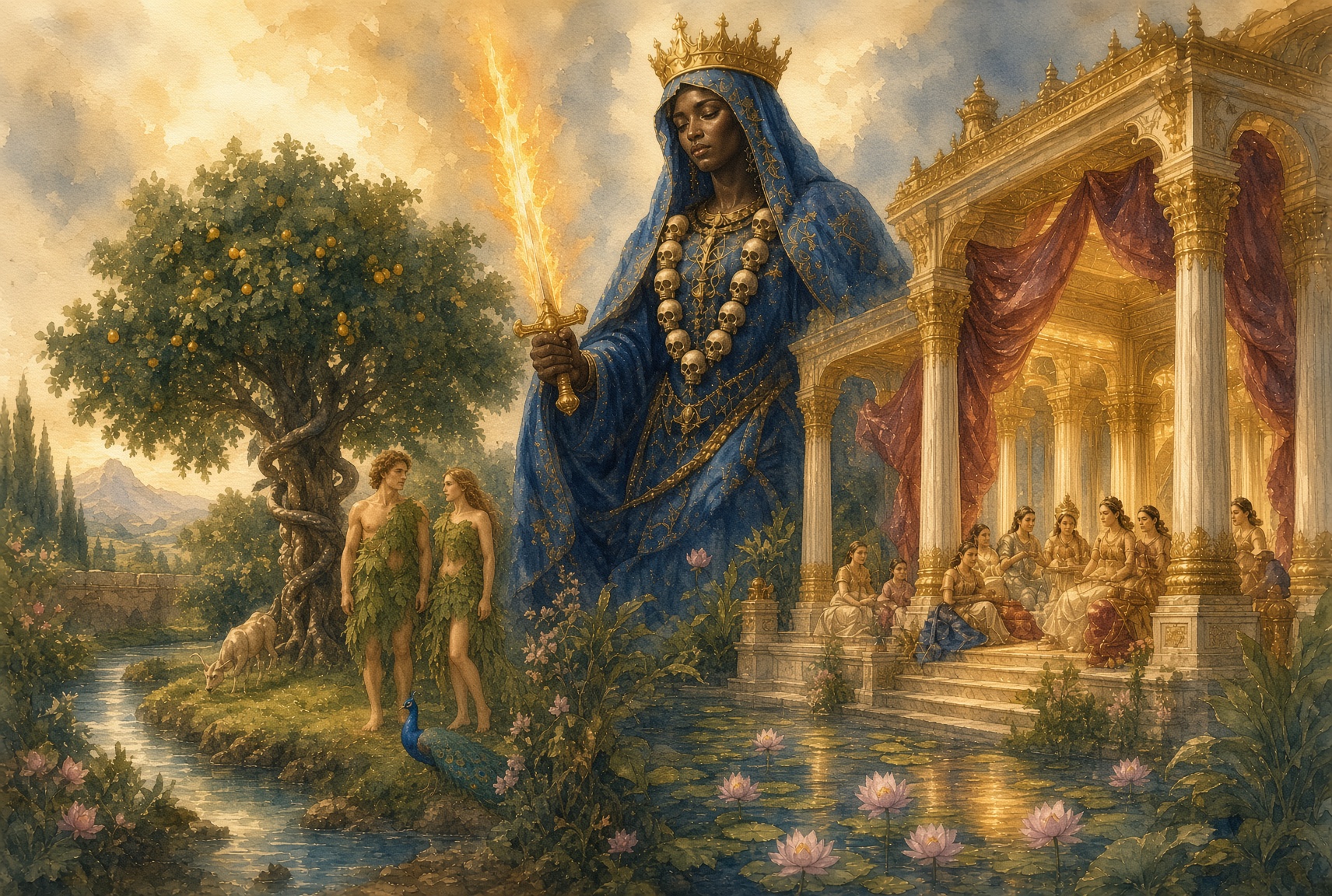
Genesis and Enlightenment: The Necessary Transition from Unconscious Paradise to Responsible Self-Awareness
Dear brothers and sisters, this lecture juxtaposes the creation narrative of Genesis with the path of development of the enlightened one. Both stories follow the same archetypal pattern: the transition from a protected, unconscious state to the painful yet liberating self-awareness. This transition is the prerequisite for the rediscovery of the Logos, for the individuation of the soul, and for the harmonious union of healthy masculinity and healthy femininity. The following section elaborates on the content of the lecture and considers its psychological and spiritual implications.
The Walled Garden and the Protected Palace
Both narratives begin with a state of security. In Genesis, it is the Garden of Eden—a walled, well-irrigated place where humankind is not yet aware of its nakedness. There is no sense of shame, no fear of death, and no foresight regarding the future. Human beings live in a balance between nature and culture, without the burden of self-reflection.
The same motif appears in the story of the enlightened one: The young prince grows up in an artificially protected environment. His father ensures that suffering, old age, sickness, and death remain completely hidden. Only youth, health, and joy are visible. The prince lives in an artificial innocence, corresponding to the state of childhood and the unconscious paradise.
Both places are images of original, unreflective being. They represent the state in which the soul does not yet bear the full weight of existence. But this state is not final. It must be broken through so that humanity can become the bearer of the Logos.
The Encounter with Chaos and the Collapse of Paradise
In both stories, chaos appears in the form of an encounter. In Genesis, it is the serpent—subtle, hidden, and yet seductive. It brings the knowledge of good and evil. Human beings' eyes are opened. They recognize their nakedness, their vulnerability, and their mortality. The immediate consequence is shame, the sewing of fig leaves as a first form of cultural protection, and expulsion from the garden. Work, sweat, and the sting of death enter the picture.
In the story of the enlightened one, there are three encounters: the old man, the sick man, and the dead man. These encounters destroy the protected state. Innocence collapses. The prince realizes that everything is subject to decay and death. The artificial palace loses its power. The search for a path to liberation begins.
Both narratives describe the same psychological and spiritual process: The unconscious state of security dies. The chaos of mortality and vulnerability breaks in. This is the moment of Nigredo—the dark phase in which the old innocence perishes.
The Birth of Self-Awareness as the Price of Knowledge
The lecture makes it clear that self-awareness is the central price of this transition. As long as humans are unaware of their nakedness, they lack the necessary reflective distance from themselves. With the realization of this nakedness arise shame, fear, and the ability to foresee the future. Humans begin to sacrifice the present to shape the future. Work becomes necessary. Moral knowledge emerges: the distinction between natural suffering and willful malice.
This self-awareness is not merely a punishment. It is the prerequisite for humanity to participate in the ordering principle. The Logos—the creative word that calls form from chaos—can only truly be borne when humanity accepts the burden of knowledge. Without this step, humanity would remain trapped in innocence and incapable of genuine responsibility.
The Logos as the Ordering Principle and the Rediscovery of the Father
At the heart of both stories lies the ordering principle. In Genesis, God speaks the word, and from the chaos, light and form emerge. Humankind is created in the image of this ordering spirit. He receives the ability to name, to shape, and to transform chaos into order.
This principle is the Logos. It is the reversal word that simultaneously kills and awakens. It kills the illusion of innocent comfort and awakens the soul to true freedom and responsibility. The lecture shows that a person only becomes truly human when they submit to this Logos and allow it to work within them.
This is also the return to the symbolic Father—God in Heaven, the origin of all order. The soul finds its orientation not in fleeing from responsibility, but in the voluntary acceptance of the ordering word.
The Black Madonna and the Path to Healthy Femininity
In this process, the symbol of the Black Madonna appears as an image of Sophia. She represents healthy femininity: receptive, wise, and capable of bearing the pain of realization without suppressing or glorifying it. The Black Madonna is neither sentimental nor destructive. She is dark, mature wisdom that absorbs the flaming sword of the Logos and raises it to a crown.
Healthy masculinity orders, protects, and sacrifices itself for the whole. Healthy femininity receives, nurtures, and transforms. Their union is love as completeness. This union finds its concrete expression in the intact family of mother and father. There, the child's soul grows in a protected yet ordering space. The family is the microcosm of the greater order established by the Logos.
The Path of Individuation and the Responsibility of the Individual
The lecture emphasizes that the path of the soul is the path of individuation. The hero must confront chaos, rescue ossified tradition, and establish a new order. This is not achieved through ideological homogenization, but through the voluntary acceptance of responsibility. The individual who bears the Logos enlivens culture. Culture serves the individual who renews it.
This path is sober and yet hopeful. It demands courage. It demands the willingness to accept the Fall and, from it, to shape the resurrection of the soul. In the rediscovery of the Logos, in the return to the Father, and in the wholesome polarity of man and woman lies the liberation of the soul.
Brothers and sisters, the Fall is not a defeat. It is the necessary step toward maturity. Whoever consciously bears it becomes a bearer of the Logos—within themselves, in their family, and in their culture. This is the practical yet profoundly spiritual path that these ancient stories show us.