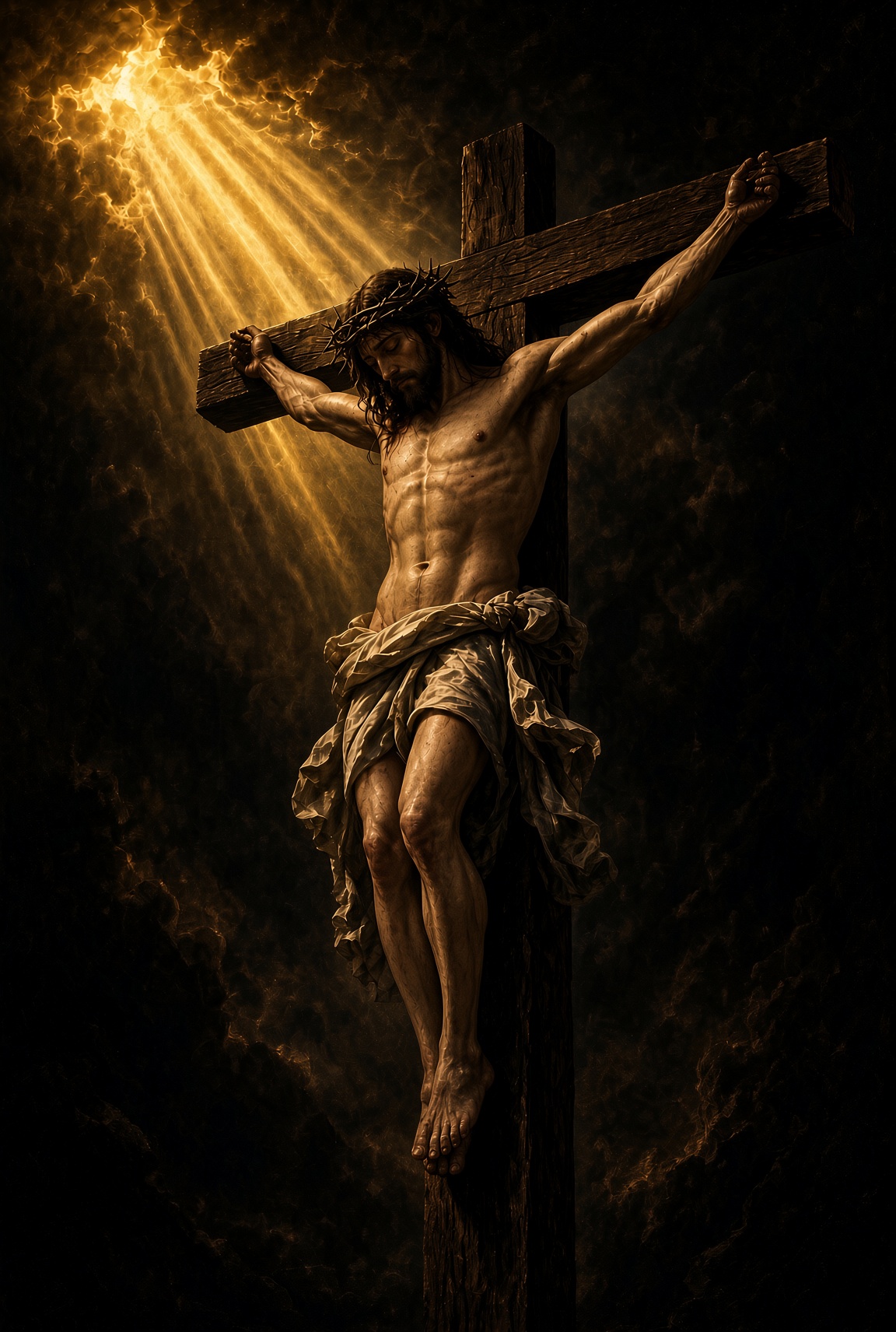
Jesus Christ – The Paradox of the Divine Logos on the Cross
Dear brothers and sisters, in the profound dialogue of the soul, the central paradox of the Christian faith unfolds in a clear and deeply moving way: the Logos, who is God and remains with the Father, becomes flesh—and does so in a world compromised by sin. The cross appears not merely as a moral example, but as a metaphysical transformation of reality. The Son bears the entire dysfunction of fallen creation—cruelty, hatred, violence, and institutional injustice—in obedience to the Father, transforms it through forgiveness, and returns in the resurrection with the greeting of peace, "Shalom," to the traitors. The wounds remain visible as signs of real brokenness, yet divine mercy proves to be greater.
The Entry of the Logos into Fallen Flesh – The Living Word
The starting point of the paradox lies in the biblical conception of the divine itself. Scripture systematically separates the Supreme from all natural and human projections: neither sun, moon, and stars, nor idols, nor earthly rulers may represent the Absolute. Rather, the divine is revealed in a human form that remains both unattainable and worthy of imitation. This “Word,” which was with the Father from the beginning and is God, becomes flesh. Crucially, however, it does not enter an unaltered creation, but rather flesh already compromised by sin.
The cause of this compromise is described as “corrupted” or “misguided freedom.” Creation, in its very structure, bears the consequences of a misused will. Thus, the Son does not enter an ideal paradise, but a reality characterized by dysfunction. This entry is already the beginning of redemption: The Logos accepts the fallen condition without separating itself from unity with the Father. Herein lies the first core of the paradox—unrestricted divinity encounters unrestricted human brokenness.
The Cross as a Sustaining and Transforming Reality
On the cross, the dysfunction of the world is concentrated in its highest form. It is the site of cruelty, hatred, violence, institutional injustice, and human folly. The Son bears all this without denying the Father and without relinquishing unity with him. The sacrifice of the cross does not please the Father because an angry, dysfunctional Father would demand blood. Such a notion is explicitly rejected. Rather, the Father rejoices in the Son's free entry into the fallen condition and in the restoration of unity through obedience and love.
The words, "Father, forgive them, for they do not know what they are doing," mark the decisive turning point. Here, dysfunction is neither denied nor met with counter-violence, but rather absorbed into the greater divine mercy. The Logos "swallows up" the brokenness of the world. This is not merely a moral stance that individuals could emulate to redeem themselves. Such a view would approach Pelagianism—the notion that humanity can save itself through its own moral efforts. The cross, rather, is an ontological transformation: Reality itself is reordered as divine mercy absorbs and transforms human dysfunction.
The Resurrection as Confirmation of Greater Mercy
The resurrection makes visible what already happened on the cross. The risen Christ returns to those who betrayed and abandoned him and greets them with "Shalom"—universal peace. The wounds remain visible. They are not a cosmetic trivialization, but lasting signs of the world's real brokenness. This very fact makes it clear that divine love and mercy are greater than any evil—even greater than the act of killing God.
Where sin has become abundant, grace proves to be even more abundant. The resurrection is therefore neither a mere metaphor nor a simple psychological symbol of inner rebirth. It is the confirmation that the metaphysical order of reality has been reconstituted through the obedience and forgiveness of the Son. The Logos has borne the dysfunction and overcome it in unity with the Father.
The Call to the Soul: Individuation and Turning to the Father
This paradox presents the soul with a clear decision. It is not enough to merely consider Christ as a moral example. The encounter with the cross and the resurrection demands a deeper movement: individuation, the dying of the old self, so that the Self can gain space. Turning to the symbolic Father in heaven is the return to the Logos, who establishes order, meaning, truth, and goodness.
In this reversal, healthy masculinity and healthy femininity find their union and completeness. Love becomes visible as the power that leads both to a vibrant wholeness. The Black Madonna as Sophia stands here as a symbol of the path to healthy femininity: she wears the darkness of Nigredo, the deep blue robe of wisdom, the golden crown of transfiguration, and the flaming sword of the discriminating Logos. In her, the soul is reminded of the source from which both the masculine and feminine souls receive their healthy form.
Healthy families with a mother and father thus become the earthly reflection of this heavenly order. They are places where the Logos is lived concretely and where the individuation of children and parents can flourish in security and responsibility.
Courageous acceptance of the paradox
The paradox of the divine Logos on the cross does not call for an escape from suffering, nor does it trivialize human brokenness. It demands free, obedient entry into the depths of reality—just as the Son did. In the religious tradition that professes the Father, the Son, and the Holy Spirit as the unconditional source of truth, goodness, and beauty, the soul finds its lasting home.
Brothers and sisters, let yourselves be seized by this paradox. The word that kills also awakens life. The blackness of the cross holds the light of the resurrection. Turn to the Father, let the soul walk the path of individuation, and live the union of healthy masculinity and healthy femininity in the light of the divine Logos. Thus, reality itself is renewed.