The Destruction of Sodom and the Rebirth of the Soul through Sacrifice and Hospitality
Dear brothers and sisters, the ancient tale of Sodom and Gomorrah is far more than a historical event or a moral warning. It is a profound drama of the soul, a mystery of Nigredo, in which the chaos of unbridled lust and disregard for the sacred confronts the divine Logos. In Abraham's attitude, the path of individuation is revealed: the courageous turning to the symbolic Father in heaven, the readiness for sacrifice, and the openness to the stranger as a messenger of the Higher. Here, the soul is redeemed from the darkness of sybarism and violence and led back to sacred order.
The Encounter with the Stranger as the Beginning of Renewal
Everything begins with the encounter. Three men—angels, messengers of the unseen—approach Abraham. He runs to meet them, offering water, bread, and rest. He treats the stranger not as a threat, but as the bearer of a potential blessing. This hospitality is not a sentimental gesture or a mere social ideal. It is a courageous acknowledgment that the unknown, that which lies outside the familiar, often bears the call of the Logos.
The stranger is the unconscious, the foreign element within ourselves and in the other, which, when received with worthiness, bestows new life. Abraham receives the promise of a son, the renewal of the covenant, the prospect of offspring that fill the heavens like stars. The soul that makes room for the higher becomes itself fruitful. Here, healthy masculinity is already evident: not possession, but responsibility and openness. It is supported and complemented by healthy femininity, by Sophia, that profound intuition, and by the unconscious, which, like the Black Madonna, sustains and completes the masculine. In this union, love arises as true completeness.
The Chaos of Sodom and the Shadow of Unbridled Desire
In Sodom, however, dysregulated passion reigns. The men of the city do not seek encounters with strangers, but rather violent possession. Here the shadow reveals itself in its rawest form: the impulse to rape the other instead of honoring it. The often simplistic interpretation that reduces this scene solely to a specific sexual orientation misses the point. It is about the fundamental attitude toward the unknown and the sacred.
Whoever responds to the stranger—and thus to the divine in its unpredictability—with violence and lust destroys the order that sustains life. The city becomes the symbol of a culture that sacrifices to the moment of pleasure and abandons the future, responsibility, and dignity of the other. This is the collective Nigredo, the dark phase, in which the old is revealed in its depravity. Without this revelation, there is no purification. The shadow must be seen so that it no longer reigns unconsciously.
Sacrifice as the Path of Renewal and the Invention of the Future
Sacrifice is at the heart of the entire narrative. Abraham's life is a series of stages in which the old must be relinquished so that the higher can enter. Sacrifice is the invention of the future. It is the conscious decision to discard what is unnecessary—old habits, arrogance, fear, and sybaritic self-absorption—in order to follow the Father's call.
Whoever clings to the present, to what is comfortable, to base instincts like the monkey who doesn't open its fist and thus remains trapped, loses life. Sacrifice kills the base and simultaneously awakens the higher. It is the word of reversal, the sword of the Logos, which both judges and enlivens. In the psychological language of the soul, this means individuation: liberation from identification with the mere ego and orientation toward the Self, which has its origin in the symbolic Father.
The Covenant and Circumcision as Signs of Inner Transformation
Circumcision, the covenant that encompasses the whole house, is the outward sign of an inner truth: a part must die so that the whole may live. It is not an arbitrary demand, but the sacred sign of surrender. The old self is cast off, the new one is born. This covenant extends not only to the individual, but to the entire household—to wife and children, to strangers within the home. Here, the healthy family becomes visible: father and mother in their complementary order, which preserves the covenant across generations and introduces children to sacred responsibility.
The family is the first and most important place where the Logos takes shape. Without it, the soul falls into the isolation of the mere individual or into the anonymity of the masses. Orientation recognizes in this the order willed by God, in which masculine and feminine complement each other and together serve the higher purpose.
The intercession and hope of the righteous
Even in the face of judgment, the possibility of grace remains. Abraham acts as an intercessor. He negotiates with the Most High, from fifty righteous people down to ten. A small minority of goodness is able to halt the destruction. This is the hope of the soul: that even amidst the collective shadow, the individual who remains true to the Logos possesses saving power.
This intercession is not cheap optimism. It is the courageous belief that good, however insignificant it may seem, is more powerful than evil when it opens itself to the divine will. Here, the depth of the soul becomes visible: The soul that turns to the Father itself becomes the mediator between chaos and order.
The Nigredo and the Rebirth of the Soul
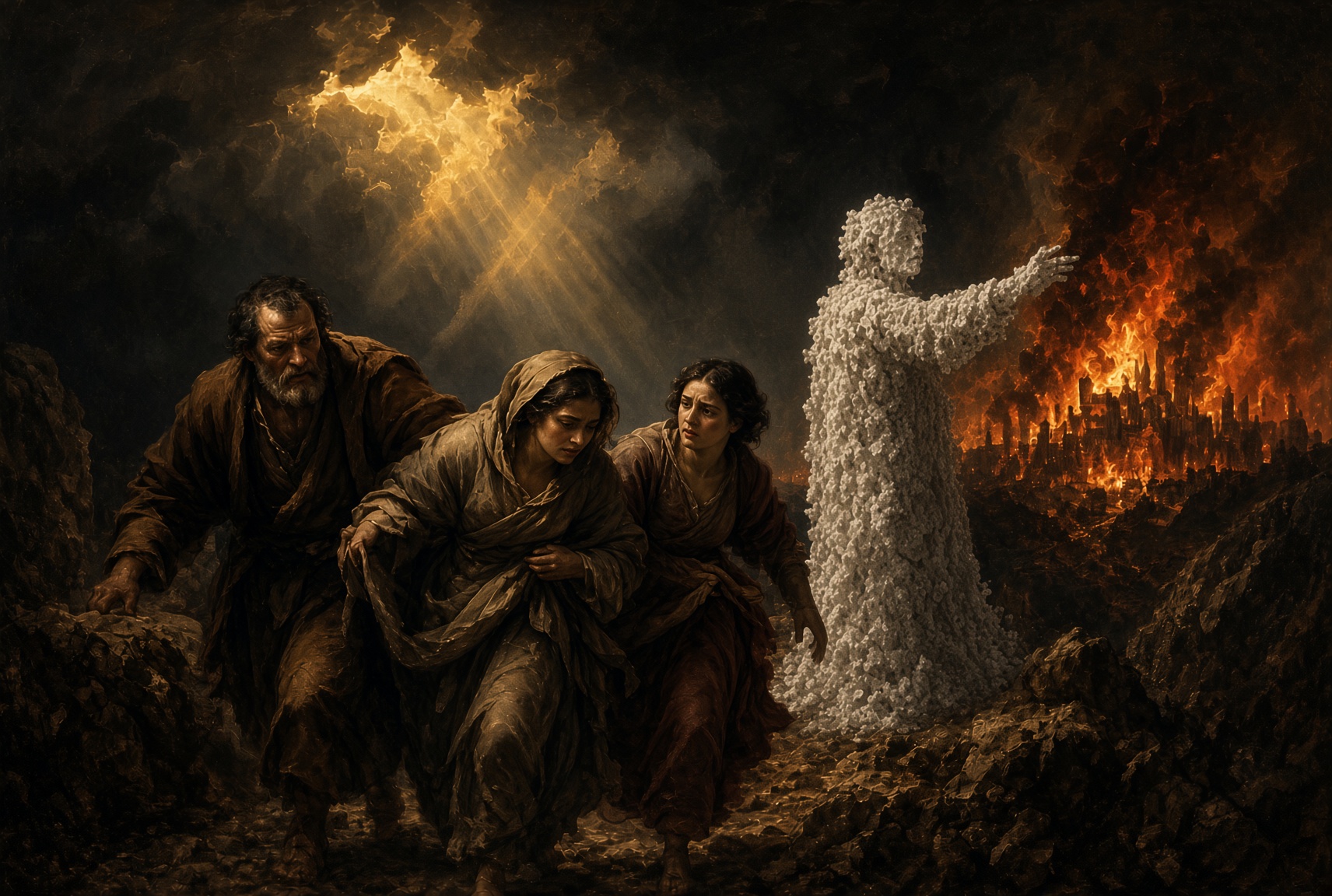
The judgment that comes upon Sodom is not an arbitrary punishment. It is the necessary consequence of an order that has fallen out of balance. The alchemical Nigredo, the dark phase of dissolution, enters. The old must die so that the new can be born. Lot and his family are led out, but the warning remains: Do not look back. Those who mourn the old chaos will turn to salt, like Lot's wife.
Rebirth occurs only through complete letting go. The soul that walks the path of individuation experiences this process within itself. The shadow is confronted, the sacrifice is made, the covenant is renewed. Then, from the darkness, the light of the Logos rises. The soul is liberated—not for selfish self-realization, but for participation in divine life.
The call to repentance and healthy order
The Logos, the divine word, speaks through the narrative. Repentance toward the symbolic Father in heaven is not an escape from the world, but the prerequisite for truly standing within it. Healthy masculinity is revealed in Abraham's courageous hospitality, in his responsibility for the household, and in his willingness to sacrifice for the greater good.
The soul that walks this path is liberated. She learns to face the stranger with courage, not to succumb to her own shadow, and to serve the Logos. The chaos of Sodom is present in every person and in every culture. But the answer is not resignation, but the courageous decision to make sacrifice, to practice hospitality, and to remain faithful to the Father. Then new light emerges from darkness, rebirth from judgment, and the path to wholeness from mortal life.
Go forth and act accordingly. Repentance is possible. The Logos calls. The soul that answers finds life.