From Patricide to the Forest Path – The Meaning of Life for the Atheist
Anyone who does not recognize an immortal soul faces a radical existential task. For atheists, there is no ready-made script in heaven and no divine plan of salvation that will catch them at the end of time. If man does not have a metaphysical soul, he has only one reality left: he must understand himself as a historical being.
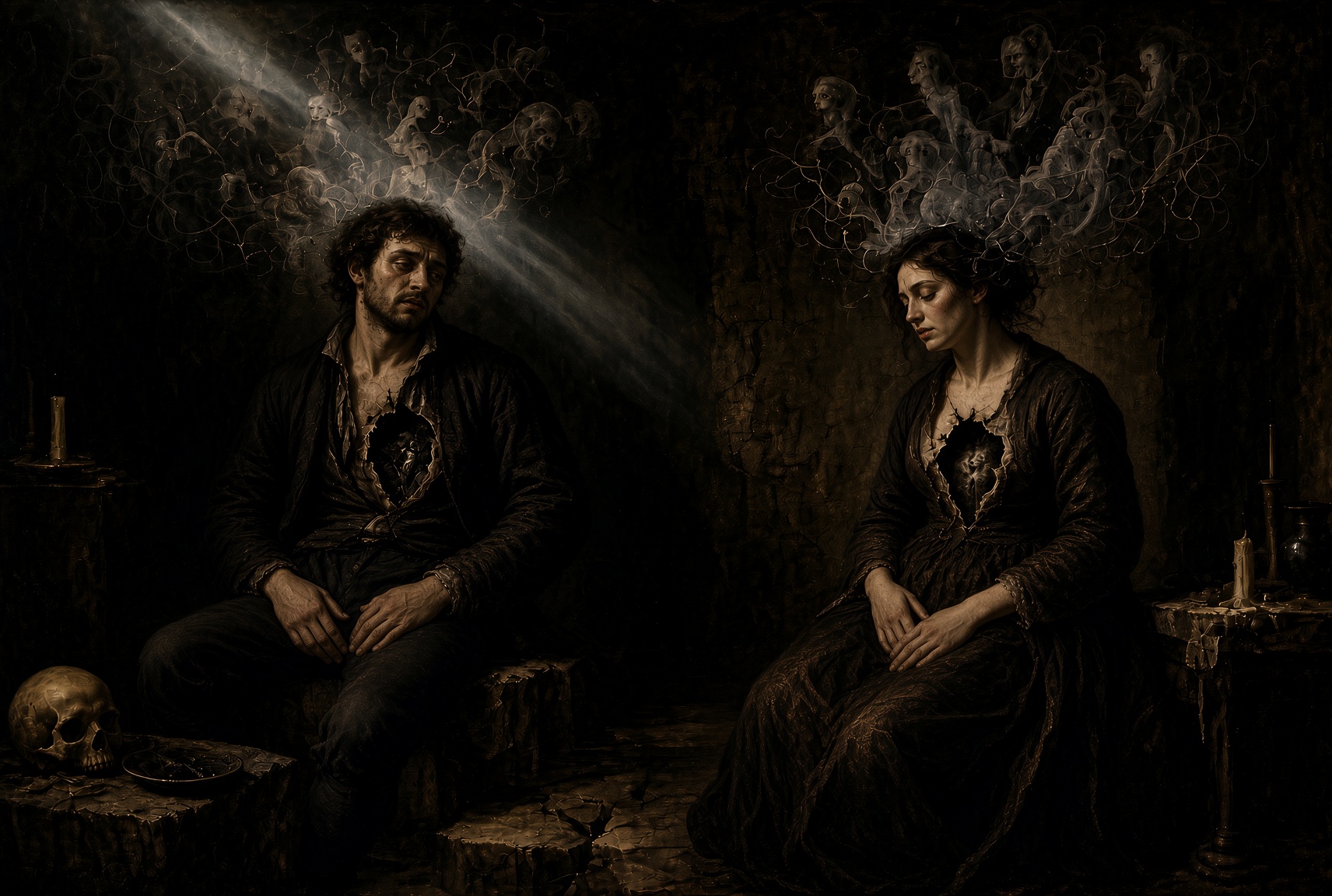
This means: meaning is not found in the afterlife, but must be actively built in the here and now, embedded in the flow of human history. However, primal psychological fears lurk on this path of maturation. Anyone who buries God must be careful not to freeze to death in the cosmic cold. The atheist must embark on an existential hero’s journey – the transformation from Oedipus to Hansel and Gretel.
The Oedipus Complex of the Atheist: Killing the Father
At the beginning of the atheistic awakening there is often an unconscious, almost mythological act: the Oedipal parricide. In psychoanalysis, Oedipus kills his father in order to have his mother all to himself. Applied to intellectual history, this means: The atheist mentally kills the original father - religion, God, the law and the transcendent order. He shatters the patriarchal corset of the church in order to finally be free.
But why does he do this unconsciously? To be allowed to stay in “mother’s” bed. This mother is regression, the longing for the state of pure, needless security in which one does not have to take responsibility for one's own existence. It is the desire to remain in the protected, infantile space of nature or pure nihilism, where there are no duties, no sin and no higher judgment. One basks in the illusion that liberation from the father is already the end point of the journey.
The ejection into the evil world
However, this Oedipal illusion does not last forever. Sooner or later, man is thrown out of the comfort zone of nature and youthful rebellion into the evil world. Suddenly the atheist realizes the fundamental hardness of his philosophy: If there is no God, there is no cosmic justice. There is no Creator to explain the suffering and no Savior to wipe away the tears at the end. Reality is cold, mechanical and indifferent.
Anyone who stops at this point as Oedipus remains in defiance or despair. Anyone who refuses the responsibility to face the realities of history slips into passivity. And here the greatest danger awaits: the metamorphosis of the protective mother into the mother of death. The mother of death is paralyzing nihilism, depression, the feeling of absolute meaninglessness that slowly eats away at the human spirit because it cannot cope with death as final nothingness.
The Rescue: How the Atheist Must Become Hansel and Gretel
To avoid being devoured by the Mother of Death, the atheist must undergo fundamental psychological maturation. He must put aside Oedipal defiance and internalize the narrative of Hansel and Gretel. What do Hansel and Gretel do when their parents abandon them in the deep, dark forest (the godless, indifferent world)?
They don't fall into a state of shock: they don't complain about the loss of their parents' home.
They use their wits: they start scattering pebbles and breadcrumbs. They leave traces.
They accept their fate: They organize themselves, stick together and finally defeat the witch (the mother of death) by pushing her into the oven. For the modern atheist this means: Since there is no predetermined path, he must - like Hansel and Gretel in the forest - lay out his own pebbles. These stones are culture, values, family, art, science and historical awareness.
Meaning through historical heritage
The meaning of life for the atheist lies not in the passive consumption of existence, but in scattering traces in time. As a historical being, he recognizes: I am the product of those who came before me and I bear responsibility for those who go after me. He finds dignity and meaning in cultivating the forest of existence, creating values and bringing order to chaos. Anyone who manages to get out of Oedipal defiance and into the creative responsibility of Hansel and Gretel can no longer be harmed by the death mother of meaninglessness. He rests in his historical duty.