The Phenomenology of the Divine – On the Spirit of the Father, the Fall of the Tower, and the Return of the Logos
Dear brothers and sisters in spirit, this leads us deep into the chamber of the soul, to where the divine is still experienced as a living voice, as presence, and as a call. It concludes the narrative of Noah, interprets the Tower of Babel, and opens the way to Abraham. What happens here is not merely an interpretation of ancient texts, but an alchemical process of conversion: The soul recognizes the Spirit of the Father, shatters the pride of self-power, and turns to the living Logos—that Word which simultaneously judges and awakens, kills and calls to life. In the language of mysticism and the psychology of the soul, the path of individuation is revealed here as a return to the symbolic Father in heaven.
The Phenomenology of the Divine - The Naked Father and Sacred Vulnerability
After the flood, which confines the chaos of the world within ordered boundaries, Noah plants a vineyard. He drinks the wine and becomes naked. His son Ham sees the nakedness and speaks of it—he makes his father's vulnerability the subject of talk and mockery. The other two sons, however, turn their faces away, take a garment, and cover their father by walking backward. The curse that falls upon the mocker and his descendants is not an arbitrary act of an angry God, but the inner necessity of the soul: Whoever despises the spirit of the father loses the strength that springs from reverence for what has been handed down and falls into bondage to their own impulses and chaos.
Here, Scripture teaches what the psychology of the soul has known since Carl Gustav Jung: Nakedness is the symbol of conscious vulnerability. Human beings who become aware of their limitations and their dependence stand before the abyss. Mockery of this nakedness is a betrayal of the spirit of the father—of that order which has preserved us from chaos, of the culture that, like the ark, protects us from the flood. Whoever mocks this spirit destroys their own foundation. Healthy masculinity rests on respect for what came before us. Healthy femininity—as Sophia, as the awake intuition of the unconscious—supports this foundation instead of undermining it. Without this reverence, the family disintegrates, and without the family, the soul disintegrates.
The Tower of Babel and the Pride of Self-Power
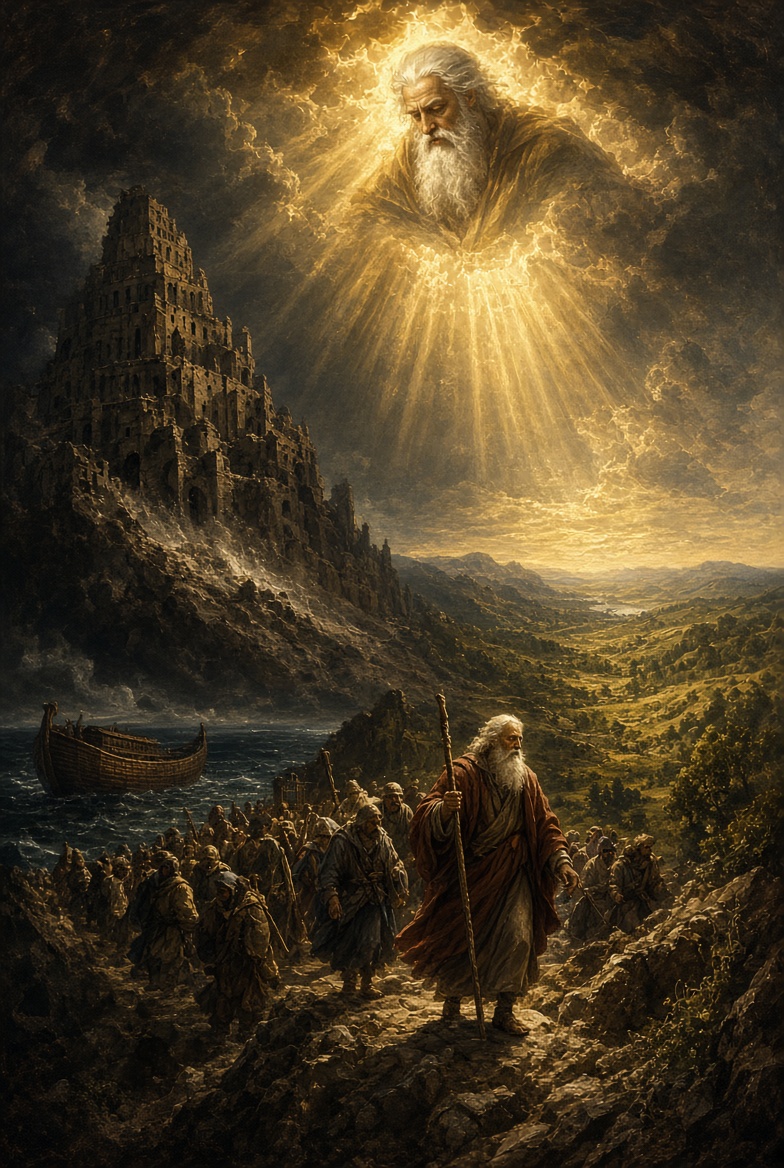
Then the tower rises. A people with one language and one will builds to storm heaven and place the name of man above the name of God. They want to make a name for themselves and prevent dispersion. The Logos responds not with outward force, but with the confusion of tongues. The unity of self-power shatters. What appeared as progress and security proves to be totalitarian arrogance.
The tower is the image of every human presumption that denies the divine and seeks to control the complexity of creation through its own will alone. In the language of mysticism, this is the fall of Lucifer: Reason, which worships its own works and makes itself the measure of all things, plunges into the hell of meaninglessness. Every epoch erects new towers—ideological systems, boundless economic constructs, utopian visions that separate humanity from both earth and heaven. Dispersion is grace. It compels the soul to descend again, to turn to the ground of reality and humility. Pride shatters, so that the path to the Father may be cleared once more.
The Appearance of the Divine and the Phenomenology of the Soul
Amidst these stories, the true phenomenology of the divine begins. God still appears personally—as a voice, as presence, as a covenant partner. For modern humanity, which often knows the divine only as an abstract concept or a distant idea, this becomes both an annoyance and a profound invitation. The soul possesses an innate capacity to experience the transcendent. In moments of profound stillness, in the stirring of the unconscious, in those states where the limited ego recedes and the unity of being shines forth, the Logos touches the soul.
These experiences are not pathology. They are a remembrance of the origin. Mysticism recognizes them as visions, the psychology of the soul as encounters with the Self. The Logos, the living Word, slays the false self—hubris, contempt, fear—and simultaneously awakens the true self. It is the sword that divides and the love that reunites. In this manifestation, the soul becomes the bride who recognizes the heavenly bridegroom. The Black Madonna, as a symbol of Sophia, represents the dark, fertile depths of the unconscious—not as a counterforce to the Father, but as that intuition which carries and complements the masculine, so that both may together serve the Logos.
Conversion as the Path of Individuation
The doctrine that emerges here is that of individuation in the Christian tradition. In the Catholic sense, the soul is not liberated by rejecting the Father, but by turning back to Him. Healthy masculinity and healthy femininity find their fullness only in the love that comes from the Heavenly Father and takes shape in the earthly family as mother and father. The family is the earthly reflection of the heavenly order. Where mother and father stand in reverence before the Logos, the souls of their children are strengthened and guided on the path of truth, beauty, and goodness.
This path is difficult. It demands the acknowledgment of one's own nakedness, the renunciation of the tower of self-power, and the constant readiness to follow the call. Yet it is the only path that leads to freedom. In the silence of the Nigredo Monastery, in the dark beginning of transformation, the light begins. The Logos calls incessantly. Whoever hears Him and turns back passes from bondage to sonship, from chaos to order, from death to life.
Thus, the lecture becomes a call to conversion. Whoever honors the spirit of the Father, whoever leaves the tower of their own hubris and follows the call of the Divine, embarks on the path of the soul. This path is courageous because it demands humility; it is optimistic because the Logos never ceases to call. Turn around. The Father waits. The soul may return home.