Adam and Eve – The Necessary Fall into Self-Awareness
Dear brothers and sisters in spirit, here the ancient creation narrative of Adam and Eve is revealed as a cosmic event: the birth of human self-awareness from the state of the unconscious and the naive. These few paragraphs contain the realization of vulnerability, death, willful evil, shame, and the beginning of the true story as an arduous journey. It is the Nigredo moment of the soul—the dark descent that simultaneously awakens the Logos. Yet in the traditional narrative, Eve remains too much in the unconscious and too firmly entrenched in the purely physical. It is precisely this one-sidedness that challenges us to read her figure more deeply and to recognize the necessary path from the physical woman to the wise Sophia.
The Garden as a Space of Tension Between Chaos and Order
The Garden of Eden is not only a naive idyll of innocence, but also the walled space in which nature and culture, chaos and order, exist in fruitful tension. Water, as a symbol of formless potential, surrounds him; the walls contain the disordered, allowing fertility to flourish. Human beings are formed from the dust of the earth and receive the breath of life. They are both dust and spirit—a being that exists between heaven and earth.
In this space, two trees stand at the center: the Tree of Life and the Tree of the Knowledge of Good and Evil. The prohibition against eating from the latter is not an arbitrary restriction, but rather the first boundary that makes consciousness possible. Without a boundary, there is no inside and outside, no self and other. The boundary is the beginning of distinction, and distinction is the beginning of Logos.
The Serpent and the Birth of Self-Awareness
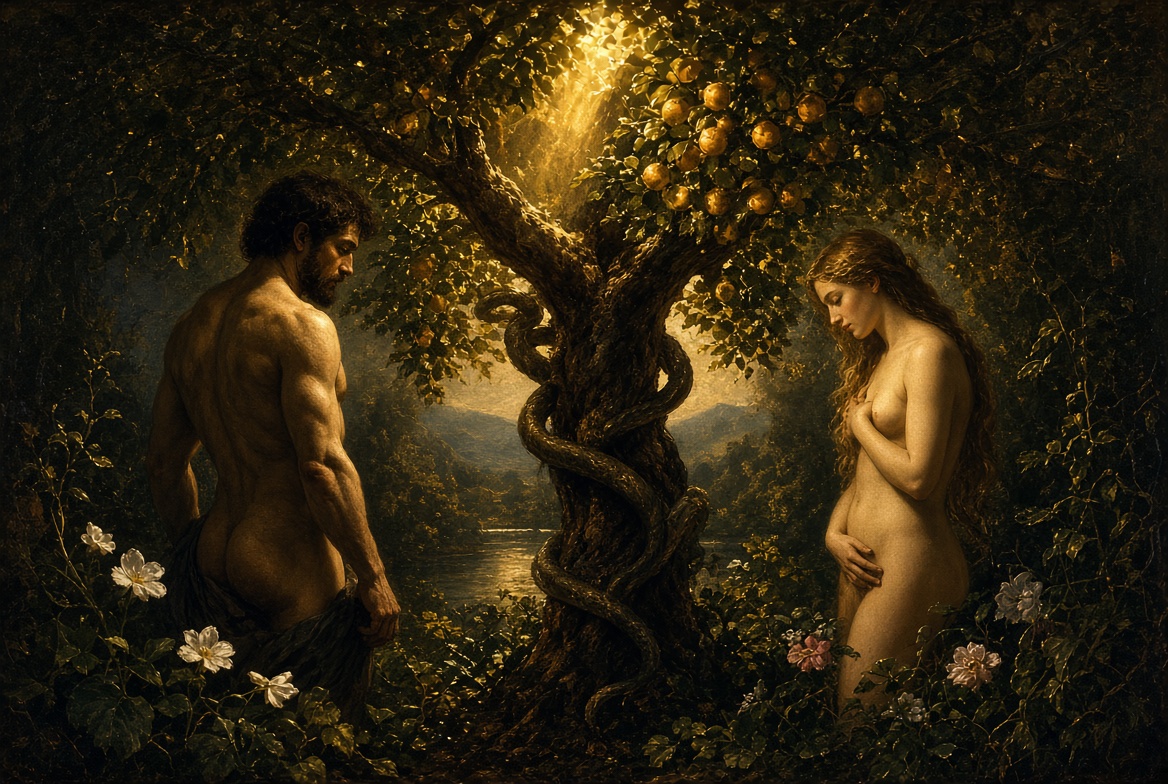
The serpent appears as a hybrid being—neither purely animal nor purely spiritual, subtle, with an intelligence that transcends instinct. It utters the temptation: “You will be like God, knowing good and evil.” At that moment, the unconscious is pierced. The fruit is eaten, and the eyes are opened.
What happens is not an external accident, but the inner breakthrough of self-awareness. Human beings realize they are naked. Nakedness here does not merely mean physical exposure, but the sudden experience of vulnerability. The body is exposed to scrutiny, judgment, pain, and death. The innocence of unconscious unity shatters. The soul emerges from the paradise of ignorance into the world of time, finitude, and responsibility.
This is the nigredo of transformation: the blackening in which the old form dies. Self-awareness tears a rift in being. Human beings now know they will die. Time begins. The toil of labor, the pain of birth, the banishment from the garden—all this necessarily follows from this realization.
The Origin of Intentional Evil
With the knowledge of one's own vulnerability arises the ability to recognize this vulnerability in others and to consciously exploit it. This is the origin of intentional evil. Animals kill on instinct. Humans can kill with knowledge. He can deliberately inflict on the other what he himself fears. The knowledge of good and evil is not merely moral information, but the capacity to will evil.
Herein lies the profound tragedy and, at the same time, the magnitude of the Fall. Evil becomes possible because good is recognized. The soul now faces a decision: Will it protect the other's vulnerability or exploit it? This decision is the beginning of moral freedom and the beginning of history as a struggle between light and darkness.
Shame as the First Call to Repentance
The immediate consequence of this knowledge is shame. Adam and Eve hide themselves and cover their nakedness. Shame is not merely an embarrassing feeling, but the first psychological pain of alienation. It is the sign that the soul has become aware of its inadequacy before the divine.
But it is precisely here that the word of repentance resounds. God seeks humanity and asks: 'Where are you?' This question is the sword that simultaneously kills and gives life. She destroys the illusion of innocence and awakens the soul to responsibility. The shame that initially leads to hiding becomes a call to turn back to the symbolic father—God in heaven. Without this conversion, humanity remains hidden in self-deception. With conversion begins the path of individuation.
Eve—too unconscious and too corporeal: The necessary path to the wise Sophia
In the traditional narrative, Eve appears too deeply rooted in the unconscious and simultaneously too deeply entrenched in the purely corporeal. She hears the serpent's voice, answers, grasps, and eats. Her actions remain closely tied to the body, to grasping, to eating, to immediate sensual temptation. She acts as the open vessel of
The disordered and the corporeal, which only later draws man into understanding. Eve is the pure bearer of the unconscious and the physical.
A deeper reading calls upon us not to leave Eve in this state. An inner development is necessary: from the physical woman to the wise Sophia. The physical woman is the necessary starting point—she carries life, fertility, sensuality, and the unconscious. But she must not remain there. She is called to transform herself into the conscious Sophia, the living wisdom who knows and sanctifies the corporeal without being dominated by it.
In the figure of the Black Madonna, we encounter this transformed Eve: She carries the unconscious and healthy intuition, yet she carries them awake and ordered. The flaming sword shows that Sophia not only receives but also separates, judges, and serves the Logos. She supports and complements the masculine, instead of overwhelming or dominating it.
Healthy femininity and healthy masculinity find their union in marriage. Man and woman become “one flesh”—not as a fusion of the sexes, but as a restoration of the original unity under the higher Logos. Marriage thus becomes the place of truth, where one can no longer hide and therefore must grow. In healthy families, where mother and father complement each other, this mystery is lived out concretely. The Eve of the narrative, portrayed as too unconscious and too corporeal, must be raised within ourselves to the awakened Sophia, so that the soul does not sink into the chaos of the unconscious and the merely physical, but goes to meet the Father.
The Beginning of the True Story and the Path of Individuation
With the Fall, the true story begins: the story of conscious effort. Man must till the field, woman gives birth in pain, both are aware of death. Yet it is precisely this effort that is the place of sanctification. The soul that confronts shame, opens itself to the Logos, and turns to the Father finds its way back.
The entire subsequent path of Scripture is humanity's attempt to deal with this rupture. Truth becomes the healing word. Speaking the truth brings order out of chaos. The individuation of the soul is the path of liberation: from unconscious paradise through the dark fall to conscious love, which unites the good, the true, and the beautiful.
The sword that kills also awakens. The soul that confronts shame and opens itself to the Logos finds its way back to the Father. The Black Madonna, Sophia, holds the unconscious and intuition ready so that the masculine does not ossify in dry reason and the feminine does not sink into formless chaos or mere physicality. Both serve the one Logos, who created the world through the Word and restores it through the Word.
May this realization work within us: that the fall is not the end, but the beginning of true humanity. That shame leads to repentance and death to hope for life, which is stronger than death. That we find the courage to turn to the symbolic father and seek in the love of healthy masculinity and healthy femininity the completeness that is given to us in the Logos.